Fiesta de San Sebastián 2026 in Adeje: History, Traditions, Program & Everything You Need to Know

Update – Events cancelled
Source
The celebrations of the San Sebastián Feast scheduled for Monday 19 and Tuesday 20 January have been cancelled following the decree of three days of official mourning issued by the Spanish Government after the tragic railway accident in Andalusia, in which around fifty people lost their lives, with others still missing and many injured. This decision, announced by the Mayor of Adeje, José Miguel Rodríguez Fraga, was taken out of respect for the victims, in solidarity with their families and with the people of Andalusia, and in line with the municipality’s institutional commitment in moments of serious collective grief.
If there is one celebration that perfectly captures the soul of Adeje, blending faith, history, animals, sea air, fireworks, and centuries-old promises kept, it is without doubt the Fiesta de San Sebastián.
Held every January, this deeply rooted festivity is not just a religious event—it is a living tradition that connects modern Adeje with its rural, agricultural, and spiritual past.
In 2026, the Fiesta de San Sebastián will take place on 19 and 20 January, once again transforming the area around Plaza de San Sebastián and La Enramada into a gathering point for locals, pilgrims, riders, families, and visitors who want to experience a celebration that still feels genuinely Canarian.
This guide covers everything:
✔ the origins of the festival
✔ why animals (especially horses) are central
✔ the full 2026 programme
✔ where it happens
✔ how to participate responsibly
✔ and why this fiesta matters so much to Adeje
Grab a coffee (or a barraquito ☕), because this is a story worth taking your time with.
When Is Fiesta de San Sebastián 2026?
The Fiesta de San Sebastián 2026 takes place over two days:
- Monday, 19 January 2026
- Tuesday, 20 January 2026 (the main day of the celebration)
These dates are fixed in the local calendar and coincide with the liturgical feast day of San Sebastián Mártir, protector against epidemics and guardian of animals.
Where Does the Fiesta Take Place?
The heart of the celebration is:
- Plaza de San Sebastián
- The Church of San Sebastián
- The surrounding area of La Enramada Beach, where the iconic procession toward the sea takes place
Unlike many festivals that move locations over time, San Sebastián in Adeje has a deep geographical meaning. The proximity to the sea is not decorative—it is symbolic, historical, and spiritual.
A Festival Older Than You Think: Origins of San Sebastián in Adeje
The Fiesta de San Sebastián dates back to the early 16th century, making it one of the oldest continuously celebrated traditions in southern Tenerife.
Originally, the festival was organized by farmers and livestock keepers from Adeje and across the island. For these communities, animals were not just companions—they were survival itself. Disease, epidemics, or drought could wipe out livelihoods overnight.
San Sebastián became the saint to whom people turned in times of crisis.
Promises were made.
Miracles were attributed.
And when favours were believed to be granted, the fiesta was paid for and celebrated.
That cycle of devotion—request, promise, gratitude—is still alive today.
From Sacred Ground to Sacred Sea: A Unique Spiritual Journey
Long before Christianity, the area now associated with San Sebastián already had a spiritual significance. Historical research suggests that:
- The site was originally used for aboriginal Guanche rituals, involving prayers and invocations by the sea.
- Later, the Virgin of the Encarnación was venerated in the area known as El Humilladero.
- Once that devotion moved elsewhere, the small temple was dedicated to San Sebastián, chosen specifically as a protector against epidemics.
This choice was no coincidence.
Throughout Adeje’s history, epidemics affected not only people—but animals as well. Horses, goats, cattle, and donkeys were essential for agriculture and transport. Protecting animals meant protecting life itself.
The Image of San Sebastián: Art, Emotion & Devotion
The statue of San Sebastián of Adeje is not just a religious object—it is a work of art with extraordinary emotional power.
- Created in Valencia, at the Casa Bririllo
- Arrived in Adeje in 1916
- Documented in Gaceta de Tenerife on 29 January 1916
Artistically, the sculpture shows:
- Mannerist classicism
- A Praxiteles-style curve, giving fluid movement to the body
- A facial expression combining pain and transcendence, often compared to Bernini’s “Ecstasy of Saint Teresa”
Carved in wood and polychromed, the figure is slightly smaller than life-size—but its presence is immense.
Above all, what makes this image powerful is not just craftsmanship, but generations of devotion.
How the Tradition Evolved Over Time
For centuries, the celebration followed a very physical ritual:
- On 18 January, the image was taken up to Santa Úrsula Parish
- On 19 January, it processed through Adeje
- On 20 January, it was carried on foot and on shoulders down to the old seaside hermitage
This demanding pilgrimage reflected devotion in its most literal form.
By the late 1970s, the long transfers stopped. Since then, the festival has been celebrated entirely in the area of La Enramada, closer to the sea and better suited to the growing number of participants.
Since 1993, following the disappearance of the Cámara Agraria, the Ayuntamiento de Adeje has been responsible for organizing the festivities.
Why Animals Are the True Stars of San Sebastián
One of the most distinctive features of this festival is the blessing of animals.
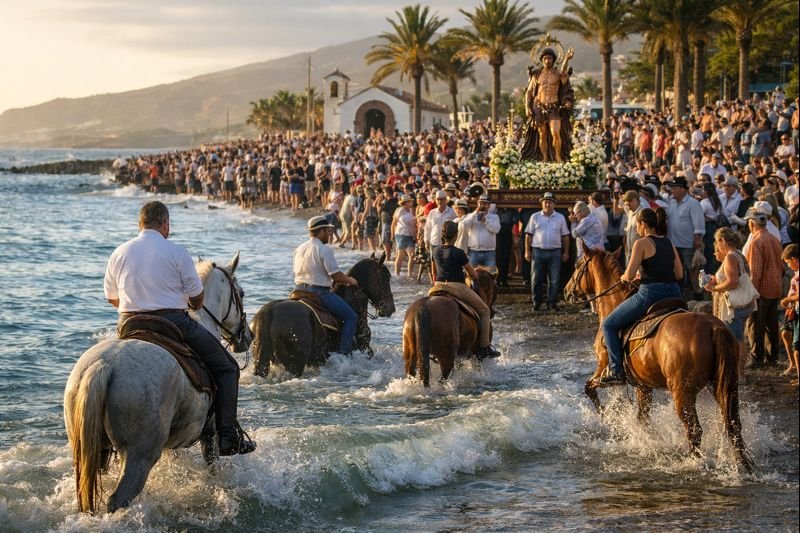
While you will see dogs, goats, and other domestic animals, horses dominate the scene. In recent editions, over 100 horses have participated.
After the main mass:
- The saint is taken in rogative procession toward the sea
- Riders guide their horses into the water
- A spectacular display of horsemanship unfolds, blending devotion and tradition
This is not a show.
It is a promise fulfilled.
Animal Registration: What You Must Know for 2026
To protect animal welfare and ensure safety, registration is mandatory.
Key Rules for 2026
- Registration deadline: 16 January 2026
- ❌ No same-day registrations accepted
- Registration must be completed online only
- Animals are supervised by veterinary professionals
- Water, shade, and designated areas are provided
Registration is done through the official website of the Ayuntamiento de Adeje.
For questions:
- 📧 sansebastian2026@adeje.es
- 📞 +34 922 756 246 (Centro Cultural de Adeje)
Respecting these rules is essential to preserve the festival’s character.
Official Programme – Fiesta de San Sebastián 2026
Monday, 19 January 2026
- 19:30 – Sung Mass by Grupo Mesturao
- 20:30 – Procession with the image of San Sebastián, accompanied by the Banda del Patronato Musical de la Histórica Villa de Adeje
- Fireworks offering upon return to the church
- 21:00 – Performance by Parranda Chasnera
Tuesday, 20 January 2026
- 12:00 – Solemn Eucharist sung by Boleros de Armeñime
- Procession with Agrupación Musical Ntra. Sra. de Las Nieves
- Traditional blessing of animals
- 18:00 – Evening Eucharist
Beyond Religion: A Community Celebration
While the festival has strong religious roots, it has long surpassed the boundaries of faith alone.
San Sebastián is:
- A meeting point for generations
- A reminder of Adeje’s rural past
- A moment of shared identity in an increasingly modern municipality
You will see:
- Elderly locals who have attended every year of their lives
- Young riders continuing family traditions
- Visitors discovering a Tenerife that guidebooks rarely explain
In a world of fast tourism and curated experiences, Fiesta de San Sebastián remains stubbornly authentic.
It exists because people still believe in promises, gratitude, and community.
And that is exactly why it deserves to be experienced—not consumed.
If you want to understand Adeje beyond beaches and resorts, stand quietly at La Enramada as horses enter the sea, and you will understand everything.