What Makes Carnival in Adeje Different from Other Carnivals in Tenerife

Every island in the Canaries celebrates Carnival with music, colour, and an almost unstoppable energy that spills into streets and squares, often long after the sun has disappeared. But there’s something different about Adeje — something quieter, warmer, and strangely magnetic, especially if you’ve experienced more than one Carnival on the island.
While Santa Cruz dazzles with lights, sequins, and samba rhythms designed to impress on a global scale, Adeje moves to another tempo altogether, one that feels slower, more personal, and far less concerned with spectacle. Carnival here doesn’t just happen for people as something to be watched; it happens among them, unfolding naturally within the community itself.
So what exactly makes Carnival in Adeje so different from the others on Tenerife?
Let’s pull back the glitter curtain and take a closer look
Scale vs. Soul: Why Size Isn’t the Point
Tenerife’s largest Carnival, held in Santa Cruz, is legendary, often described as second only to Rio de Janeiro in size and ambition. It’s broadcast worldwide, backed by corporate sponsors, and capable of filling hotel rooms months in advance, turning the city into a stage designed for maximum visual impact.
Adeje’s Carnival, by contrast, is unmistakably smaller, with fewer parades, a more modest budget, and far less external attention. And yet, visitors who experience both often return with the same unexpected conclusion: that Adeje’s Carnival feels more real, more grounded, and somehow more memorable.
The reason is simple. Carnival in Adeje doesn’t try to impress the world; it tries to include it.
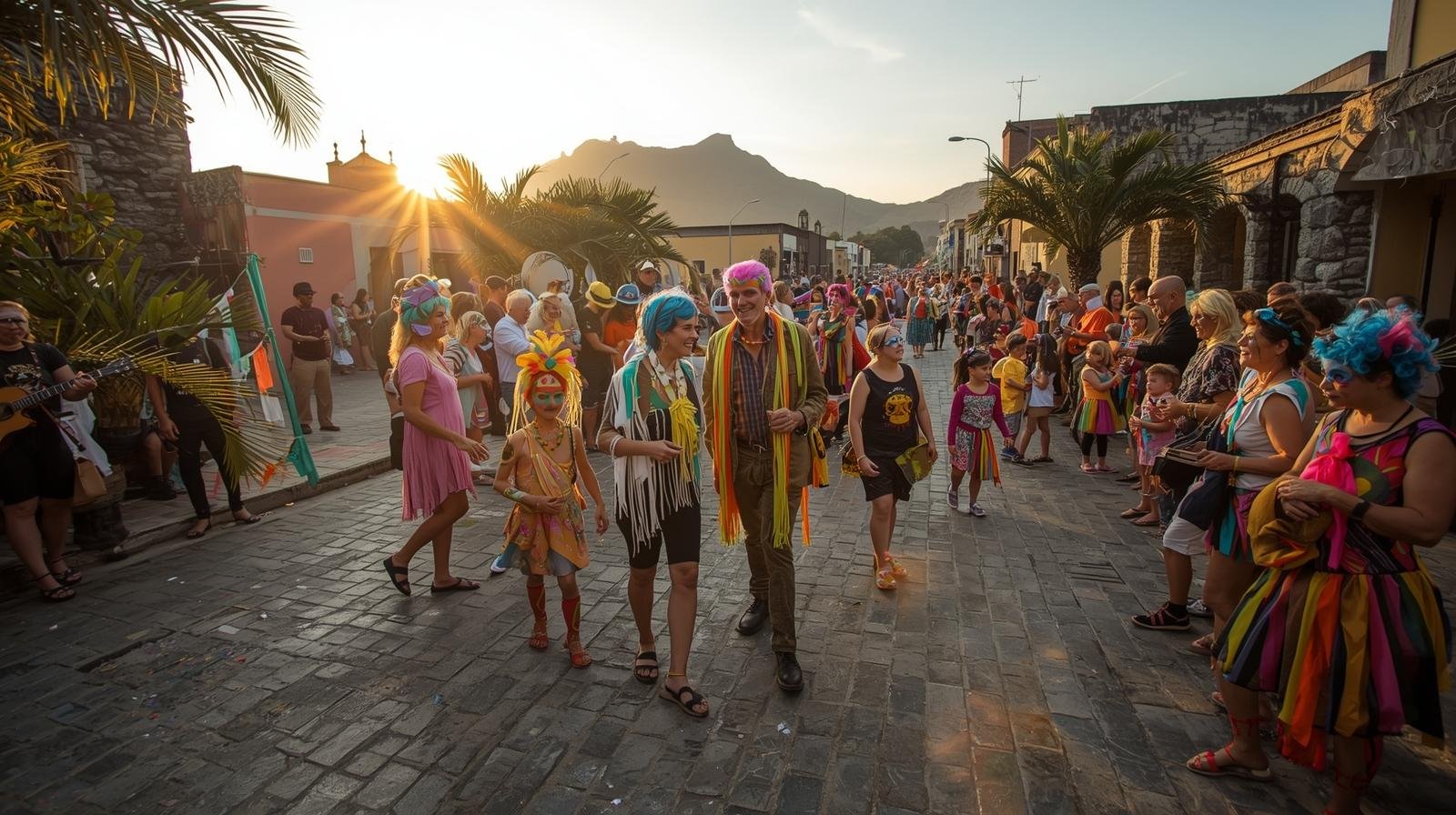
You won’t find massive floats built by professional studios or performances polished to perfection. Instead, you’ll see families, schools, neighbours, and local groups parading together in costumes made by hand, often stitched together in living rooms and community halls. It’s not about scale here, but about soul, and the difference is immediately felt.
From Spectator to Participant
In Santa Cruz or Puerto de la Cruz, Carnival can sometimes feel like a show, with thousands of people lining the sidewalks, cameras raised, watching from a respectful distance as the spectacle passes by. There is a clear distinction between who performs and who observes.
In Adeje, that line quickly blurs.
If you stand watching for too long, someone will almost certainly involve you, whether by handing you a hat, offering a mask, or gently pulling you into the rhythm of the parade. This isn’t a sign of poor organisation or improvisation gone wrong; it’s a deliberate philosophy.
Carnival in Adeje thrives on participation rather than performance. It is a celebration created with people, not staged at them, and that difference changes the entire atmosphere.
Local Roots That Run Deep
Adeje’s Carnival doesn’t borrow its identity from elsewhere, nor does it attempt to reinvent itself every year with grand themes or imported concepts. Its roots lie firmly in the town’s own history, shaped by rural celebrations, courtyard dances, and a kind of everyday humour that helped generations navigate scarcity with dignity and creativity.
Where other Carnivals focus on building large narratives, Adeje builds continuity. The music, food, and jokes all carry echoes of local tradition, from informal parrandas playing live in the streets to satirical sketches that reflect daily life, and traditional foods such as gofio and rosquetes that appear naturally as part of the celebration.
Here, Carnival becomes a form of cultural storytelling rather than spectacle, something that connects past and present without ever needing to announce itself.
Humour That Belongs to the Town
If you really want to understand the difference, listen carefully to the jokes.
In Adeje, Carnival humour isn’t imported or polished for a wider audience; it’s hyperlocal, sometimes improvised, and often delightfully specific. Skits poke fun at the mayor, traffic detours, beach closures, or even that one neighbour everyone seems to know, the references landing instantly with those who live here.
This kind of humour binds the community together. It’s cathartic, rarely cruel, and often far sharper than it first appears. In larger cities, satire can feel rehearsed and distant; in Adeje, it feels intimate, spontaneous, and sometimes whispered just loudly enough for everyone to laugh.
When the whole town understands the joke, you don’t need a stage.
A Family Affair, Not a Frenzy
Many of Tenerife’s larger Carnivals eventually shift into full nightlife mode, with events designed primarily for late nights and younger crowds. Adeje’s Carnival takes a different approach altogether.
Yes, there is music, dancing, and plenty of energy, but the tone remains deliberately inclusive. It’s not unusual to see grandparents and toddlers walking side by side in the same parade, each equally at home in the celebration.
Events are timed with families in mind, favouring afternoon parades over midnight shows, costume workshops designed for children, and family-friendly concerts held in local squares. This is a Carnival where everyone belongs, not just the loudest or the most camera-ready, and that sense of balance is one of its quiet strengths.
The Sound of Community
Adeje’s Carnival sounds different, too.
Instead of imported samba rhythms or global pop remixes, you’re more likely to hear a blend of Canarian folklore, street drumming, and Latin-Caribbean influences played live. Marching bands such as murgas and comparsas rehearse for weeks, but without the intense competition found elsewhere on the island.
They play to move people, not to win prizes.
Here, music isn’t background noise or a soundtrack imposed on the celebration; it’s the heartbeat of the town itself, rising and falling naturally as people gather and drift apart.
Space to Breathe
Visitors often notice something subtle but significant: Adeje’s Carnival gives you space.
You can walk through the crowd without being pushed, stop to talk to performers, and actually hear conversations happening around you. This isn’t a flaw or a lack of ambition; it’s a feature.
Adeje’s urban layout, with its smaller plazas, pedestrian routes, and neighbourhood streets, keeps Carnival at a human scale. You’re not swallowed by the spectacle; you’re surrounded by people, and that changes how the celebration feels from the inside.
History Woven Into the Celebration
Adeje’s Carnival still carries traces of its past, including the years when it was banned, whispered, and carefully disguised. Older participants remember stories of parents and grandparents dancing behind closed doors during the dictatorship, framing celebrations as “family gatherings” to avoid attention.
That memory adds emotional depth to the present-day Carnival. When people dance now, they’re not only celebrating joy, but also remembering a time when that joy had to be hidden. It’s a quiet acknowledgment of freedom, expressed without slogans or grand statements.
A Carnival Without Commercial Masks
You won’t see corporate logos dominating the streets or giant sponsor banners competing for attention. While the municipality supports the organisation, the spirit remains community-first.
Local artisans, bakeries, and small businesses contribute what they can, whether materials, snacks, or sound equipment, and in return Carnival gives them something far more valuable than advertising: a shared sense of identity. This isn’t a product being sold; it’s a tradition being carried forward.
The Natural Stage of Adeje
Few places offer a Carnival setting quite like Adeje.
The town’s geography, nestled between mountains and sea, turns every parade into something quietly cinematic. Palm trees, volcanic stone, and pastel houses frame the celebration, and as the sun sets behind the slopes, music begins to echo softly across the landscape.
It’s not an atmosphere you can manufacture or buy. It simply exists, and Carnival moves through it rather than trying to dominate it.
Adeje Carnival vs. Santa Cruz Carnival
Both Carnivals are beautiful, but they serve different purposes.
Santa Cruz impresses the world with scale, performance, and spectacle, drawing international attention and global tourism. Adeje, by contrast, reminds people why Carnival began in the first place: as a shared expression of community, humour, and collective release.
One amazes.
The other connects.
What Visitors Really Take Home
Ask anyone who has attended Adeje’s Carnival what they remember most, and you’ll rarely hear about costumes or floats. Instead, they’ll talk about a conversation they didn’t expect, a spontaneous dance, or a child’s smile that seemed to capture the entire atmosphere of the town.
That’s because Carnival in Adeje is built on moments rather than milestones, and moments tend to linger longer than photographs.
Staying True in a Changing Town
As Adeje continues to grow, welcoming new neighbourhoods, new residents, and new influences, its Carnival evolves as well. Yet the community remains protective of its essence, conscious that growth doesn’t have to mean dilution.
Workshops, schools, and cultural centres now pass on Carnival traditions throughout the year, ensuring future generations inherit not just the costumes, but the meaning behind them. Adeje’s Carnival may change shape over time, but it will never outsource its heart.
Carnival in Adeje stands apart because it remembers what Carnival was always meant to be: a celebration of people, not production.
In a world increasingly obsessed with being bigger, louder, and faster, Adeje quietly proves that joy doesn’t need scale to shine, only sincerity. Here, Carnival still belongs to its people, and that makes all the difference.