3-Day Costa Adeje Itinerary: A Thoughtful First Visit

For many visitors, Costa Adeje begins with a familiar image: golden beaches, oceanfront promenades, and the easy rhythm of cafés opening into the morning sun. Yet a few days here quickly reveal that the area is more layered than its postcard reputation suggests.
Costa Adeje is not simply a holiday resort. It belongs to the municipality of Adeje, a place whose recorded history stretches back to before the Spanish conquest, when the area was part of the Guanche kingdom ruled by the mencey Axerax, also known as Gran Tinerfe. Over the centuries, sugar mills, pirate defences, banana plantations, and tomato exports all shaped the landscape before tourism ever arrived. The volcanic coastline, the deep Atlantic waters, and the daily rhythms of Canarian life still run quietly underneath the resort surface.
If you are visiting for the first time, three days is enough to begin understanding the place — not only where to go, but how the days naturally unfold. This itinerary is designed with that rhythm in mind.
Day 1 — Settling Into the Coast
The first day in Costa Adeje is best spent gently adjusting to the environment. The Atlantic light, the sea breeze, and the relaxed pace of the promenade have a way of setting the tone for the rest of the stay.
Morning: Playa del Duque and the Coastal Walk
Begin the morning at Playa del Duque, one of the most distinguished beaches in the south of Tenerife. The beach stretches roughly 390 metres long and 60 metres wide, with pale golden sand and water calm enough to earn the Blue Flag certification year after year. It sits in front of some of the island’s most luxurious hotels, including the Bahía del Duque, a grand resort designed to resemble a nineteenth-century Canarian colonial village.
At the eastern end of the beach, you will notice the Castillo del Duque, a small castle-like structure that overlooks the sand and from whose curious history the beach takes its name. It is a good landmark, and a reminder that even this modern stretch of coast has older stories embedded in it.
Arrive early if possible. Before mid-morning the beach still feels spacious, and the cafés along the promenade above serve slow breakfasts with ocean views. The promenade itself is lined with palms, boutique shops, and terraces where people settle in for hours at a time.
A simple combination — coffee, fresh juice, and the sound of waves — is often the most memorable way to begin the day.
After breakfast, follow the coastal promenade south toward Playa Fañabé. This walk reveals one of Costa Adeje’s most pleasant features: the entire shoreline is connected by pedestrian paths that link at least eight beaches together. You can walk for kilometres with the ocean always beside you, passing from the quiet elegance of Playa del Duque through the livelier energy of Fañabé and Torviscas.
The pace is unhurried. People walk dogs, jog lightly, or stop for a quiet swim before continuing their day. The southwest position of the coast shelters it from the trade winds that blow harder on other parts of the island, and the breakwaters keep the Atlantic swell manageable, so the water here is usually inviting rather than intimidating.
Afternoon: Lunch and a Slow Beach Afternoon
For lunch, choose something relaxed along the waterfront — fresh seafood, grilled fish, or a simple salad with local produce. The restaurants along the Fañabé stretch tend to be busy but varied, and many serve traditional Canarian dishes alongside international options.
Afterwards, allow the afternoon to unfold slowly.
Swim, read, or simply watch the steady rhythm of boats moving across the horizon. The southern coast of Tenerife has a way of encouraging stillness, something visitors often discover unexpectedly. If you are feeling more active, the beach offers water activities ranging from classic pedal boats to parascending and flyboarding, though most people seem happiest doing very little at all.
Evening: Sunset at La Caleta
As evening approaches, head toward La Caleta, a small coastal village at the western edge of Costa Adeje. You can walk there from Playa del Duque in about twenty minutes along the promenade, passing the rocky beach of La Enramada on the way — or drive in just a few minutes.
What was once a modest fishing settlement has evolved into one of the most atmospheric dining areas in the south of Tenerife, but the village has not lost its essential character. Historical records place its origins in the sixteenth century, when the cove served as the port for the inland town of Adeje. Eighteenth-century documents describe caves carved along the coast for storing cargo from ships. For most of the twentieth century, the local population were fishermen and farmers who lived simply, many without electricity, relying on candlelight and oil lamps. The oldest part of the village, a zone called Las Terrazas, once belonged to the Fyffes Company, which used a packing building here to send fruit to England.
Today, the fishing boats still sit moored in the bay, and the fishermen are said to swim rather than sail to shore. The village remains compact and calm, with narrow streets leading toward the sea. Several of the restaurants here are considered among the finest seafood spots on the island.
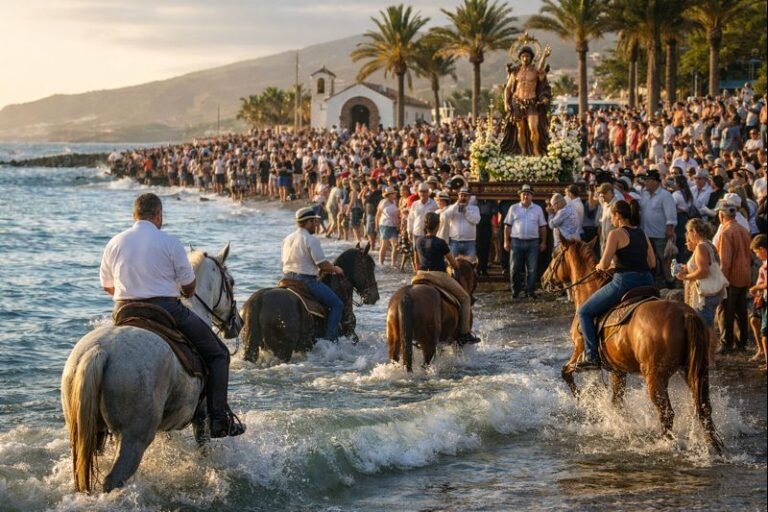
Arrive before sunset and walk along the rocky shoreline where locals gather to watch the sky change colour. In August, the village comes alive for the Fiesta de la Virgen del Carmen, when a statue of the patron saint is carried to the beach and placed on a flower-adorned boat for a procession along the coast, followed by music, dancing, and fireworks that last into the early hours. In January, a similar celebration honours San Sebastián, the village’s other patron, complete with a blessing of the animals on the beach.
Dinner here is best kept simple: fresh fish, octopus, Canarian prawns, a glass of local wine, and the quiet satisfaction of ending the first day slowly.
Day 2 — Exploring the Landscape Around Adeje
While the coast is the most visible part of Costa Adeje, the landscape behind it tells a deeper story. Within a short drive, the scenery changes dramatically — from seaside promenades to volcanic ravines and historic villages that have barely changed in decades.
Day two is about discovering that contrast.
Morning: The Old Town of Adeje
Start the day in the historic town of Adeje, just a short drive inland and uphill from the coast. The town sits in the foothills of the Tenerife mountains, at roughly 280 metres above sea level, and the views back toward the ocean are striking from this vantage point.
Unlike the resort areas, the old town still feels distinctly local. Small cafés open onto quiet streets, residents greet one another in the plaza, and the architecture reflects centuries of island history — whitewashed walls, volcanic stone, and narrow lanes built long before anyone imagined the coast below would one day draw millions of tourists.
Walk through the town centre to the Church of Santa Úrsula, which stands in the Plaza de España. The site has held a place of worship since at least 1496, making it one of the earliest religious constructions in the south of Tenerife. In 1560, Pedro de Ponte — the powerful Genoese merchant who controlled much of Adeje — began building the current structure over the original hermitage. The church has two naves, added in different centuries, and its Mudéjar-style ceiling is considered one of the most notable on the island, blending Islamic and Christian architectural traditions in a way that reflects the broader story of the Canary Islands. Inside, the church holds seventeenth-century French tapestries from the Royal Gobelin Workshops of Paris, said to be unique in the religious heritage of the archipelago, along with sculptures ranging from a German-school figure of Santa Úrsula to the oldest known replica of the Virgen de Candelaria, the patron saint of the Canary Islands. The building was declared an Asset of Cultural Interest in 1986.
Just next door stands the Casa Fuerte de Adeje, a fortified complex that once served as the political, economic, and social centre of the entire municipality for over three hundred years. Pedro de Ponte built it around 1556 to defend his sugar mill — powered by water from the Barranco del Infierno — against the pirate attacks that were common along this coast. The complex eventually grew to some 7,200 square metres and included a watchtower, stables, a bakery, slave quarters, a granary, a smithy, and a chapel. By 1655, an inventory recorded 17 cannons, 400 cannonballs, 56 muskets, and 46 pikes among its defences. A devastating fire in 1902 left much of it in ruins, but in recent years a family-led restoration has brought parts of it back to life. Today, visitors can explore the grounds for free on select mornings, guided by the owner’s daughter, whose passion for the site’s layered history — from sugar production to tomato exports to its current rebirth — makes the visit something genuinely memorable.
This is also a good area for a relaxed morning coffee — perhaps with a barraquito, the layered Canarian coffee that mixes espresso, condensed milk, Licor 43, a touch of cinnamon, and a twist of lemon peel. It arrives in a small glass, the layers clearly visible, and is one of those small local pleasures that visitors often become quietly devoted to.
Afternoon: Barranco del Infierno
From the town centre, continue toward Barranco del Infierno — Hell’s Gorge — one of the most striking natural landscapes in the municipality and a designated Special Nature Reserve.
The trail begins at 350 metres above sea level, just above the old town, and covers roughly 6.5 kilometres round trip. The hike takes about three to three and a half hours at a comfortable pace, with the path winding through dramatic volcanic cliffs, past old mills and beehives, and through vegetation that shifts from dry scrubland to surprisingly lush greenery as the canyon narrows. The gorge is home to endemic species including the booted eagle, kestrels, ravens, and Scopoli’s shearwaters, along with lizards and frogs in the damper sections near the end.
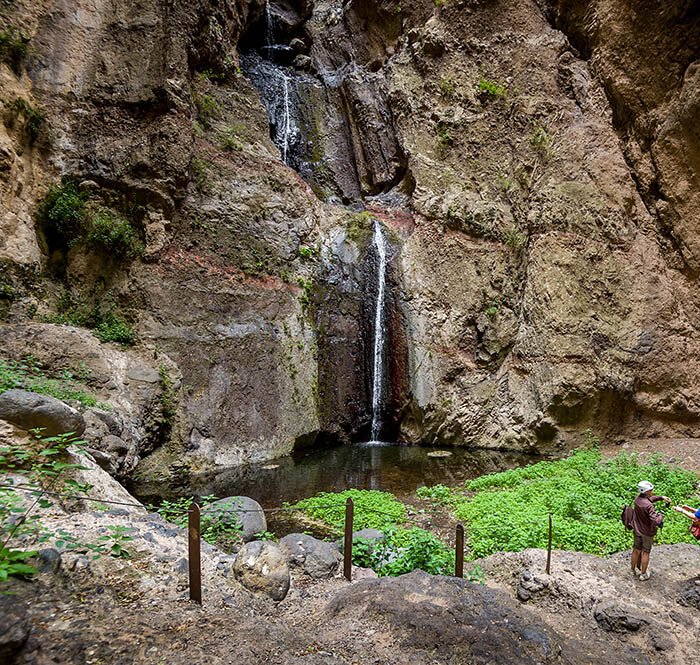
The walk ends at a waterfall of nearly 200 metres — the tallest in Tenerife. It flows more vigorously during the wetter months, and even when the water is modest, the sheer scale of the rock face and the mist rising from below make the final viewpoint worth every step.
Access is strictly regulated: only around 300 visitors are permitted per day, and advance booking through the official Barranco del Infierno website is mandatory. At the trailhead, you will collect a helmet — compulsory for the entire route due to occasional rockfall — and receive a short safety briefing. Proper footwear is checked before entry. Tickets cost around €13 for adults, and children under five are not allowed on the trail. Slots fill quickly in high season, so booking a few days ahead is wise.
It is not a technically demanding hike, but the elevation gain is noticeable and there are stairs in places, so a reasonable level of fitness helps. Bring at least a litre of water, especially in summer when the exposed sections can be intensely hot. There are no facilities along the trail itself.
This walk reveals a very different side of Adeje — one defined by geology, silence, and the deep time of volcanic landscapes rather than beaches and promenades.
Evening: Dinner in Costa Adeje
Return to the coast for dinner.
After a day exploring inland landscapes, the lights of the promenade and the sound of the ocean feel even more welcoming. Choose a restaurant slightly away from the busiest tourist streets if possible. Costa Adeje has many places where the atmosphere is calm, the service attentive, and the evening stretches comfortably into the night. If you are near Playa del Duque, the restaurant Nub — a Michelin-starred restaurant within the Bahía del Duque resort — offers an elevated take on Canarian and Latin American cuisine, though simpler options along the promenade are equally satisfying after a day spent hiking.
Day 3 — Sea, Markets, and Local Life
The final day is an opportunity to experience Costa Adeje in a slightly more local way — through markets, sea excursions, and the small routines that shape everyday life here.
Morning: A Local Market Visit
Begin the day at the Agromercado de Adeje, a covered farmers’ market housed in a modern building on Calle Archajara in the Las Torres neighbourhood of Adeje town. The market is open every Saturday and Sunday from 8:00 to 13:30, and it operates under the motto “Lo bonito de cultivar” — the beauty of cultivation.
Inside, roughly 35 stalls are run by local producers selling seasonal fruits and vegetables, Canarian potatoes, goat cheeses (some of them award-winning), local honey that varies with the island’s terrain and seasons, eggs, fresh bread, traditional sweets, and even wines and preserves. Many vendors are farmers themselves, and the atmosphere is friendly rather than commercial — people chat, ask questions, and sample things before buying. The bakery stall, in particular, has earned a devoted following among visitors for its cakes, nut tarts, and sweet potato doughnuts that are unlike anything you will find in the resort bakeries below.
The market also has a small café on the premises and parking nearby, making it a practical stop even if you are driving from the coast. Arrive early for the best selection, though products tend to hold out well until late morning.
Fresh fruit from the market — Canarian bananas, papaya, mango, or whatever is in season — makes a perfect late breakfast under the morning sun.
Afternoon: Whale Watching on the Atlantic
The waters between Tenerife and the neighbouring island of La Gomera are one of the most remarkable marine habitats in Europe. In January 2021, this stretch of ocean was officially certified as a Whale Heritage Site by the World Cetacean Alliance — a recognition of both the extraordinary wildlife and the collective efforts to protect it.
A resident population of short-finned pilot whales and bottlenose dolphins lives here year-round, in waters where the seafloor plunges to depths of 2,000 metres between the two islands. These are not seasonal visitors; the pilot whales form permanent pods, and sighting rates on responsible tours are estimated at around 99 percent throughout the year. During the winter and spring months, migratory species occasionally pass through as well — humpback whales, fin whales, Bryde’s whales, and even the rare blue whale have been recorded in these waters. Atlantic spotted dolphins, Risso’s dolphins, and sea turtles are also regularly seen.
Several responsible operators run boat excursions from nearby harbours, including Puerto Colón in Costa Adeje, with trips typically lasting two to three hours. Strict regulations govern how boats interact with the animals: vessels must maintain a safe distance, avoid chasing or crowding the pods, and keep noise levels low. The responsible operators in the area have formed an association — ACEST — that works to educate tour companies and eliminate bad practices. Some operators partner with conservation organisations like Sea Shepherd UK and the Dolphin Project.
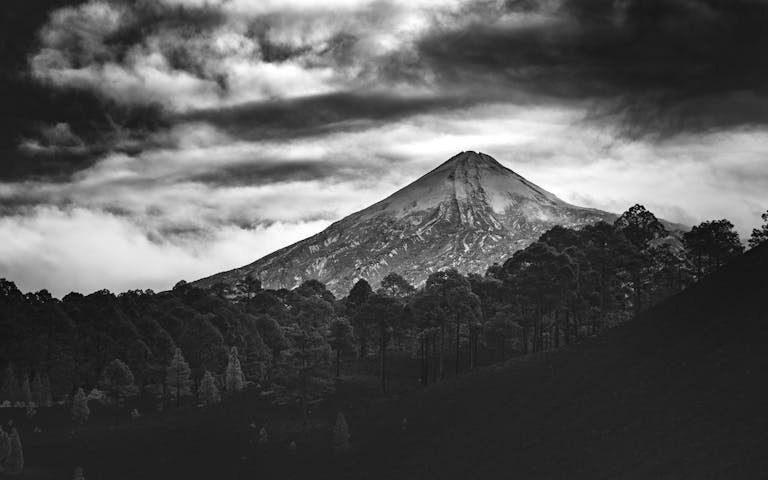
The experience itself is difficult to overstate. Watching the volcanic cliffs of Tenerife rise from the sea while pilot whales surface alongside the boat, and dolphins ride the bow wave, is often the single most memorable moment of a first visit to the island. On clear days, you can see both Tenerife and La Gomera simultaneously, with Mount Teide rising in the background — a perspective of the island’s volcanic scale that is impossible to appreciate from shore.
Evening: A Final Walk Along the Promenade
On the final evening, return to the promenade for a last walk.
By now the rhythm of Costa Adeje will feel familiar: the gentle ocean wind, the slow movement of evening crowds, the sound of music drifting from cafés, and the particular quality of the Atlantic light as the sun drops toward the horizon — a light that seems to soften and deepen everything it touches.
If you walk north from Playa del Duque toward La Caleta, there is a small elevated rocky viewpoint along the promenade that was recently refurbished with a wider path and plantings. The locals know it well. From the top, you can look in every direction — back along the resort coast, out toward La Gomera, and down into the clear water below — and it is one of those quiet spots where the full sweep of what you have seen over three days somehow comes together.
This final walk often becomes a moment of reflection. Three days is enough to see the highlights — the Blue Flag beaches, the ancient church, the gorge with its waterfall, the whales in the channel — but also enough to realise that Costa Adeje is a place many people eventually return to. Sometimes not just for holidays, but for longer stays. La Caleta, in particular, has quietly become home to a growing number of international residents who came once on holiday and found they could not quite bring themselves to leave.
And that, perhaps, is the quiet appeal of Adeje: it begins as a visit, but for some people it slowly becomes something more permanent.