
The Escrow Myth in Spain: How Real Estate Funds are Safely Transferred in Tenerife

For high-net-worth investors accustomed to the real estate mechanics of the US, UK, or Northern Europe, the Spanish property purchasing process contains a significant culture shock: the absence of a traditional Escrow system.
International buyers typically expect to wire their multi-million euro acquisition funds to a neutral third party—such as a title company or the Notary’s escrow account—where the money is securely held until the deed is signed. In Spain, this centralized escrow system does not inherently exist. Misunderstanding how funds actually change hands in Costa Adeje can lead to delayed completions, frozen bank accounts, and severe anxiety on signing day.
Here is the exact technical breakdown of how large capital transfers are legally and safely executed during a Tenerife property acquisition.
1. The Notary’s Role: Witnesses, Not Bankers
In many jurisdictions, the Notary Public handles the financial settlement of the property. In Spain, the Notary is a highly qualified public official acting on behalf of the State to verify identities, ensure legal compliance, and witness the signing of the Escritura (Title Deed).
- No Escrow Accounts: Spanish Notaries do not typically hold client funds, nor do they process the transfer of the purchase price between the buyer and the seller.
- Proof of Payment: The Notary’s responsibility is simply to verify how the payment is being made. They will physically attach copies of the bank drafts or wire transfer receipts to the back of the Title Deed as irrefutable proof that the financial transaction occurred.
2. Handling the 10% Deposit (Contrato de Arras)
When securing a luxury villa, the first significant financial exposure is the 10% non-refundable deposit paid upon signing the Contrato de Arras. Because there is no official escrow, buyers are understandably nervous about wiring €150,000 directly to a seller they have never met.
- The Seller Direct Transfer: Legally, the standard practice in Spain is to wire the 10% directly to the seller’s personal bank account.
- The Lawyer’s Client Account (The Safe Alternative): To mitigate risk, elite buyers utilize their Spanish lawyer’s designated Client Account (Cuenta de Clientes). The lawyer acts as a quasi-escrow agent, holding the 10% deposit until their due diligence is 100% complete and the Arras contract is bulletproof, only releasing the funds to the seller when it is completely safe to do so.
3. Completion Day: The “Cheque Bancario”
If the Notary doesn’t hold the funds, how does the remaining 90% change hands on completion day? The Spanish real estate market operates heavily on guaranteed bank drafts.
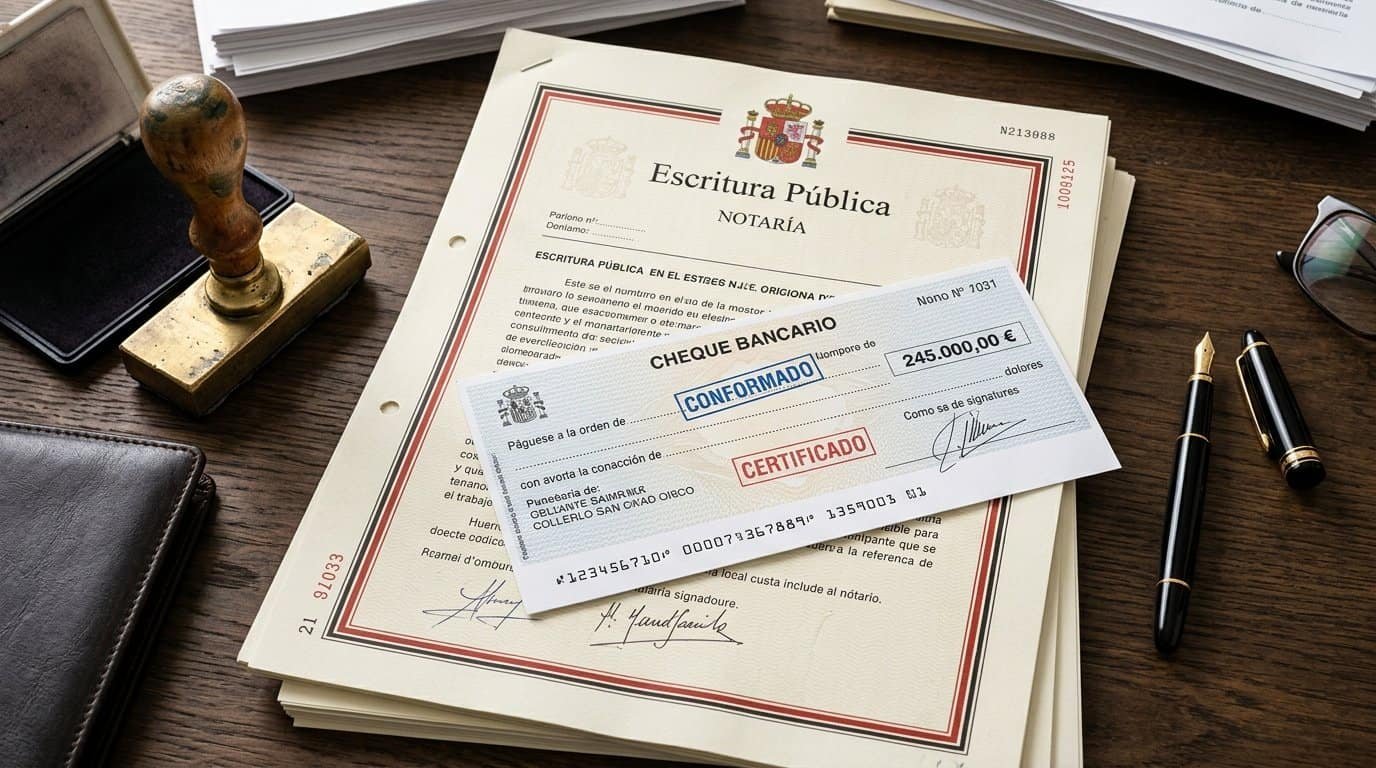
- The Banker’s Draft: On the morning of completion, your legal representative will visit your Spanish bank in Costa Adeje and authorize a Cheque Bancario (a certified, non-revocable bank draft) drawn precisely for the outstanding balance, payable directly to the seller.
- The Physical Exchange: At the Notary table, once the Title Deed is read and signed by both parties, your lawyer literally slides the physical bank draft across the table to the seller. Keys are exchanged, and the transaction is finalized.
4. The Urgent OMF Wire Transfer (For Non-Residents)
If you refuse to open a Spanish bank account, relying on a physical bank draft is impossible. The alternative is an urgent wire transfer executed directly from the Notary’s office.
- The OMF Routing: You must use a specialized Bank of Spain transfer known as an OMF (Orden de Movimiento de Fondos). Unlike standard SEPA transfers which take 24 hours, an OMF wire is irrevocable and clears into the seller’s account within 2 to 3 hours.
- The Notary Wait: The Notary will draft the deeds and both parties will sign, but the Notary will explicitly withhold the finalized documents and the keys until the seller’s bank officially confirms the OMF funds have landed.
5. The AML Clearance Hurdle
The biggest threat to transferring property funds in 2026 is Anti-Money Laundering (AML) compliance. You cannot simply wire €2,000,000 into a Spanish bank account a week before completion.
- Spanish banks will instantly freeze unverified incoming capital. You must work with your legal team 4 to 6 weeks in advance to submit your tax returns, proof of dividends, or company sale documents to the Spanish bank’s compliance department to “clear” the funds for real estate deployment.
Navigating a high-value property acquisition in Costa Adeje requires adapting to local financial mechanics; deploying your capital through a highly regulated, independent Spanish law firm operating a secure client account is the only way to replicate the safety of the escrow systems you are accustomed to at home.