The Poder Notarial: How to Safely Buy Property in Costa Adeje from Abroad

For international high-net-worth investors, flying to Tenerife to sign every preliminary document, open a bank account, or attend the final notary completion is rarely a productive use of time. The Spanish legal system accounts for this through the Poder Notarial (Power of Attorney), allowing a designated legal representative to execute the purchase on your behalf.
However, many foreign buyers mistakenly assume that a standard Power of Attorney drafted in their home country will seamlessly transfer to the Canary Islands. In 2026, Spanish Notaries and compliance departments enforce aggressively strict protocols regarding international representation. Presenting the wrong type of document will instantly paralyze your transaction.
Here is the technical breakdown of structuring a valid Poder Notarial for real estate acquisitions in Costa Adeje.
1. General vs. Specific Powers: The Compliance Trap
The most common reason a Power of Attorney is rejected at a Spanish notary table is that it is deemed “too broad.”
In many jurisdictions (like the UK or the US), a General Power of Attorney grants the representative sweeping authority to act in all financial matters. Spanish Notaries, bound by stringent Anti-Money Laundering (AML) directives, view these broad mandates with extreme suspicion.
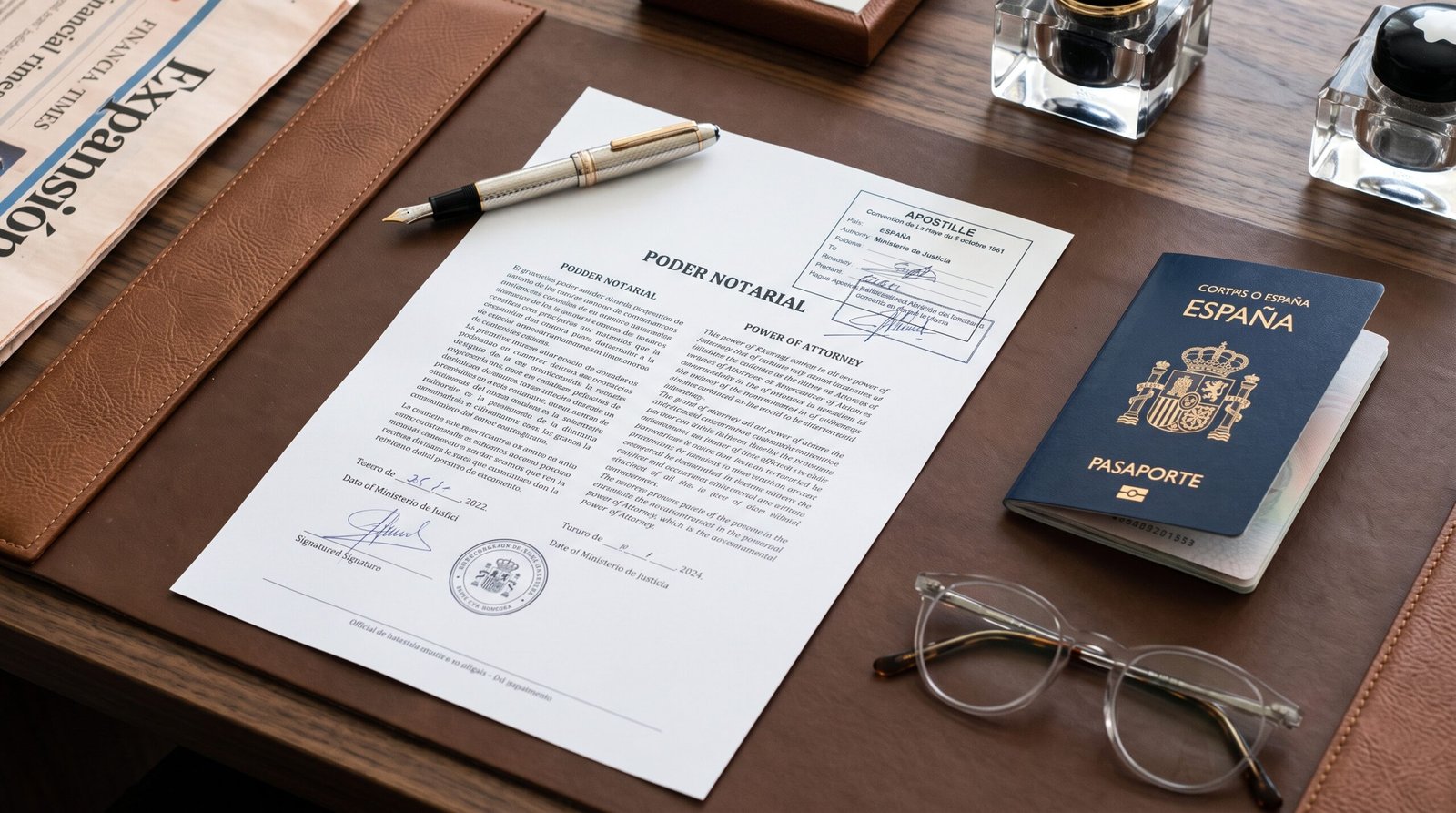
- The Poder Especial: You must utilize a highly specific Power of Attorney (Poder Especial para Compraventa).
- Mandatory Clauses: To be accepted in Tenerife, the document must explicitly list the exact actions your representative is authorized to take. This includes securing the NIE (Foreigner Identity Number), signing the Contrato de Arras (earnest money contract), opening a Spanish bank account, signing the final Escritura (public deed), and paying the associated taxes (ITP/IGIC).
- The Mortgage Exception: If you require bank financing, the POA must contain hyper-specific clauses authorizing the representative to accept debt, sign the FEIN (binding mortgage offer), and agree to the bank’s exact interest rates. Many lenders now demand their own proprietary POA templates be used if a mortgage is involved.
2. The Hague Apostille: Legalizing Foreign Documents
A Power of Attorney signed in London, Berlin, or Dublin holds absolutely no legal weight in Spain unless it has been formally legalized for international use.
- The Apostille Protocol: The document must be stamped with the Hague Apostille (Apostilla de la Haya). This is an international certification issued by the government of the originating country (e.g., the Foreign, Commonwealth & Development Office in the UK), authenticating the signature of the local notary public.
- Without the Apostille: A Spanish Notary will refuse to read the document, halting your property completion and potentially causing you to default on your deposit deadlines.
3. The Sworn Translation Requirement
Spanish Notaries operate exclusively in Spanish. If your Power of Attorney is drafted in English, German, or any other foreign language, it must undergo a certified legal translation.
- Traductor Jurado: You cannot use a standard translation agency. The document (including the Hague Apostille stamp) must be translated by an official Sworn Translator (Traductor Jurado) who is registered and certified by the Spanish Ministry of Foreign Affairs.
- Dual-Column Drafting: To save time and translation costs, elite international law firms draft the initial POA in a dual-column format (English/Spanish). The client signs the bilingual document in their home country, which is then apostilled. This eliminates the need for subsequent sworn translations in Spain.
4. Opening Bank Accounts via POA in 2026
Opening a Spanish resident or non-resident bank account is mandatory for setting up utility direct debits and transferring completion funds. Doing this remotely has become the primary bottleneck in international acquisitions.
- KYC and AML Friction: Under current Know Your Customer (KYC) regulations, many Spanish retail banks refuse to open accounts solely via a Power of Attorney. They demand visual verification of the ultimate beneficial owner.
- The Solution: Your legal representative must negotiate with private banking divisions or specialized expat branches in Costa Adeje that accept POA setups combined with asynchronous biometric verification (e.g., a secure video call link sent to the buyer’s smartphone).
Attempting to execute a cross-border real estate transaction using generic legal templates exposes your capital to severe administrative delays; deploying a hyper-specific, apostilled Spanish Power of Attorney drafted by local legal counsel ensures your acquisition proceeds seamlessly without demanding your physical presence in Tenerife.