
Planning a property scouting trip to Costa Adeje: El Duque vs. La Caleta vs. Golf Costa Adeje

Viewing properties in Costa Adeje from a tourist resort hotel rarely tells you what living there actually feels like. If you are planning a property scouting trip to Costa Adeje, where you stay for those five to ten days shapes how accurately you judge noise levels, microclimates, parking, and daily logistics.
Most serious buyers narrow their search to three neighbouring areas at the quieter, western end of the municipality: El Duque, La Caleta, and Golf Costa Adeje. On a map, they sit within a ten-minute drive of each other. In daily life, they function very differently.
Why your base matters during viewings
A standard property viewing lasts thirty to forty-five minutes, usually late in the morning when residential complexes are at their calmest. What you do not see during a midday appointment is how the wind picks up on an exposed terrace at five in the afternoon, how difficult street parking becomes near the coast on a Sunday, or how long the walk back up a steep hill feels with shopping bags.
Basing yourself inside one of the neighbourhoods you are considering—ideally in a short-term apartment rather than an all-inclusive hotel—lets you test the unglamorous parts of the routine. You quickly learn where the nearest full-sized supermarket sits, how much traffic builds up on the TF-1 slip roads during the morning school run, and whether you actually want to drive every time you leave the house.
El Duque: walkable coastal living with resort energy
El Duque stretches inland from Playa del Duque and is defined by wide promenades, well-kept residential complexes,and a high concentration of upscale hotels and shopping centres. For buyers looking at apartments, penthouses, or townhouses within walking distance of the ocean, it is usually the first area on the list.
The primary advantage of basing your scouting trip in El Duque is convenience. You can walk to the beach,pharmacies, cafés, and restaurants without touching a car, and most major real estate agencies in Costa Adeje have offices within a five-minute radius. The pavement infrastructure is flat along the coast, though it climbs steadily as you move towards El Madroñal and the upper edges of El Duque.
The trade-off is density and seasonal rhythm. El Duque is heavily populated with winter visitors from October to April,which keeps streets lively well into the evening and makes on-street parking scarce near the seafront. If you are testing El Duque as a potential home, spend a few evenings walking the exact residential streets around your shortlisted complexes after 21:00 to gauge ambient noise from nearby hotel entertainment and beach clubs.
La Caleta: village scale and a slower pace
Just west of El Duque, separated by a short stretch of coastal path, sits La Caleta. Once a small fishing village, it has evolved into one of the most sought-after residential pockets in South Tenerife, combining low-rise apartments near the bay with modern detached villas built along the hillside above the town.
Staying in La Caleta during a scouting trip gives you a noticeably different feel from the main Costa Adeje strip. There are no large commercial centres or high-rise resort blocks. Daily life revolves around the small harbour, a cluster of established seafood and Mediterranean restaurants, and the coastal walking route leading out towards the protected natural area of La Caleta.
The practical compromise is everyday errands. While La Caleta has small convenience shops and dining options, there is no large supermarket inside the village itself; weekly grocery runs require a short drive to Fañabé, El Madroñal, or Adeje pueblo. Street parking in the lower village tightens sharply around lunch and dinner hours, so if you are viewing properties here, pay close attention to whether a private garage or dedicated underground space is included in the title deed.
Golf Costa Adeje: space, quiet, and car dependency
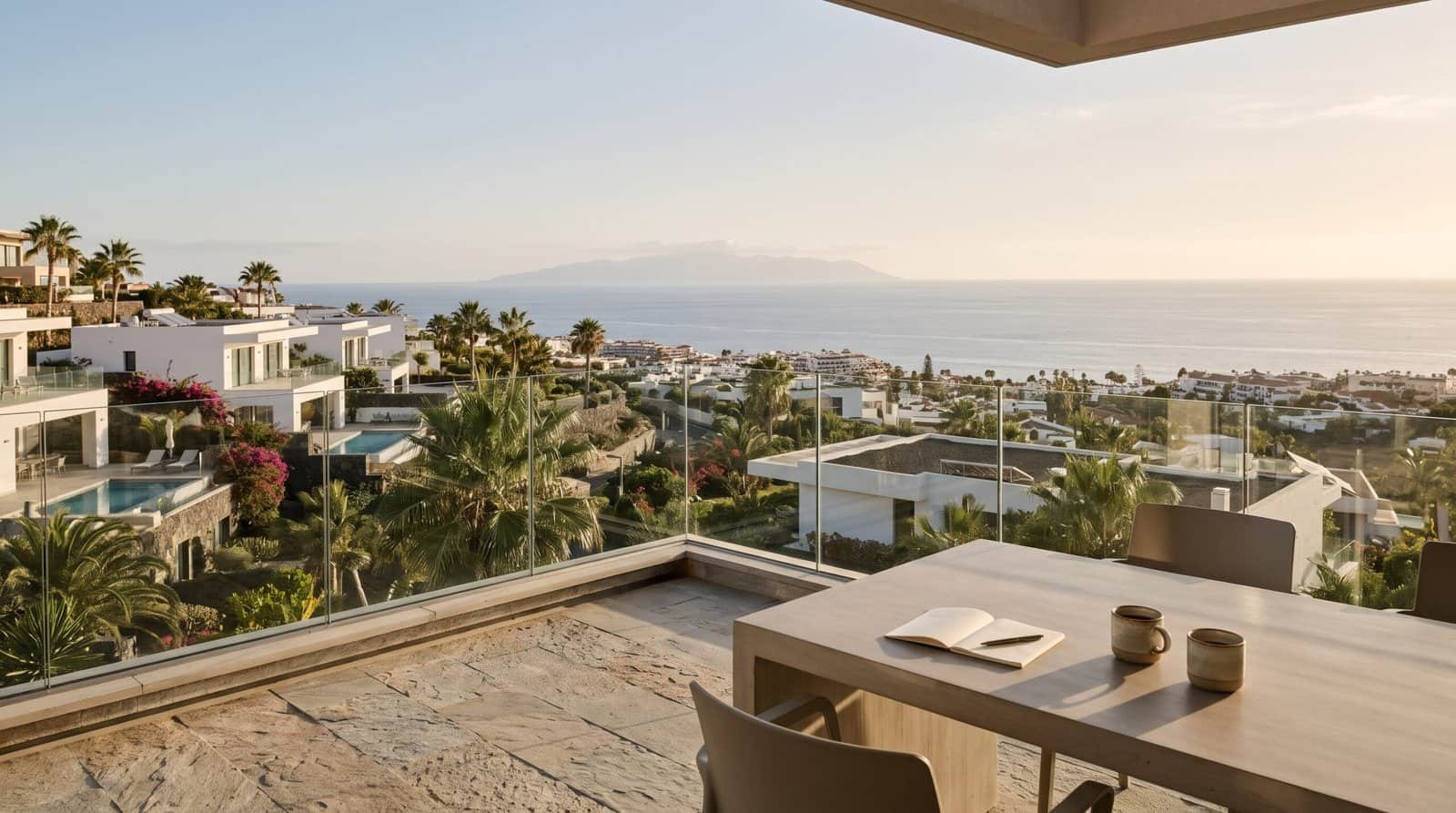
Sitting slightly inland and immediately behind La Caleta, Golf Costa Adeje occupies elevated terrain overlooking the fairways and the Atlantic towards La Gomera. The housing stock here is predominantly low-density: contemporary detached villas on generous plots and modern, gated apartment developments.
Using Golf Costa Adeje as a base makes sense if your priority is privacy, architectural space, and quiet evenings.Because there is almost no passing foot traffic and no nightlife, nights are genuinely silent compared to the coastal strip. The slight elevation also brings a steady ocean breeze, which keeps terraces comfortable during the warmer months from July to September.
The trade-off is complete reliance on a car. Walking down to La Caleta or Playa del Duque is manageable on the way out, but the return climb in midday sun is steep enough that most residents drive everywhere. During a scouting trip,test the actual driving times from the golf urbanisation to the TF-1 motorway, local international schools, and Adeje pueblo at different times of day to make sure the extra ten minutes in the car fits your routine.
How to structure a five-day scouting itinerary
Trying to view fifteen properties in two days usually leads to decision fatigue, where every white-walled terrace blurs into the next. A more effective scouting trip leaves room to observe the neighbourhoods between appointments.
- Day 1: Orientation without agents. Pick up your hire car at Tenerife South Airport (TFS), check into your base,and drive the loop connecting El Duque, La Caleta, Golf Costa Adeje, and Adeje pueblo to understand the topography and road links.
- Days 2 and 3: Focused property viewings. Limit yourself to three or four viewings per day, grouped by neighbourhood rather than criss-crossing the municipality. Take brief voice notes or photos of the street outside each building immediately afterwards so you remember the surroundings clearly.
- Day 4: Practical infrastructure. Use a full day to meet an independent Spanish conveyance lawyer (abogado),visit a local bank branch if you plan to open a non-resident account, and do a normal supermarket shop to check commute times.
- Day 5: Second viewings at a different hour. Return to your top one or two properties—or at least their streets—at a different time of day than your first visit, ideally late afternoon, to check sun orientation, wind exposure,and evening noise.
Choosing a scouting base that mirrors your realistic lifestyle—whether walkable and coastal in El Duque, compact and village-paced in La Caleta, or private and spacious around Golf Costa Adeje—turns a brief visit into a reliable test of where you will actually enjoy living. Once your shortlist narrows to one area, arranging an early consultation with an independent local lawyer ensures you are ready to act if the right property appears.