Obra Mayor vs. Obra Menor: Navigating Renovation Licenses with the Adeje Town Hall

One of the most common—and expensive—mistakes foreign buyers make in Costa Adeje is applying the renovation mindset of their home country to a Spanish property. In many jurisdictions, modernizing a bathroom or tearing down an internal kitchen wall is considered a private matter. In Tenerife, the Ayuntamiento de Adeje (Town Hall) legally requires you to declare and permit almost every type of structural and cosmetic work.
Failing to secure the correct urban license before your contractor starts swinging a sledgehammer can result in an immediate stop-work order (precinto), heavy municipal fines, and severe complications when you eventually try to sell the property.
To renovate a property in Adeje legally, you must categorize your project into one of two distinct legal frameworks: Comunicación Previa (often referred to colloquially as Obra Menor) or a Licencia de Obra Mayor.
1. Comunicación Previa (Cosmetic & Minor Works)
In recent years, Spanish urban law streamlined the process for minor renovations. You no longer have to wait months for an official “Minor Work License.” Instead, you use a procedure called Comunicación Previa (Prior Communication).
What it covers: This applies to simple conservation, restoration, and cosmetic reforms that do not alter the structural integrity, layout, or exterior facade of the building.
- Re-tiling floors or terraces.
- Replacing kitchen cabinets or bathroom sanitaryware (without moving the primary plumbing stacks).
- Painting the interior.
- Upgrading internal electrical wiring or plumbing.
The Procedure: You (or your builder) submit the Comunicación Previa form and the project budget to the Adeje Town Hall via their Sede Electrónica (online portal). Crucially, you cannot start work the next day. By law, you must submit this communication at least 15 working days before the scheduled start date. If the Town Hall does not object within those 15 days, you have tacit approval to begin.
2. Licencia de Obra Mayor (Structural & Major Works)
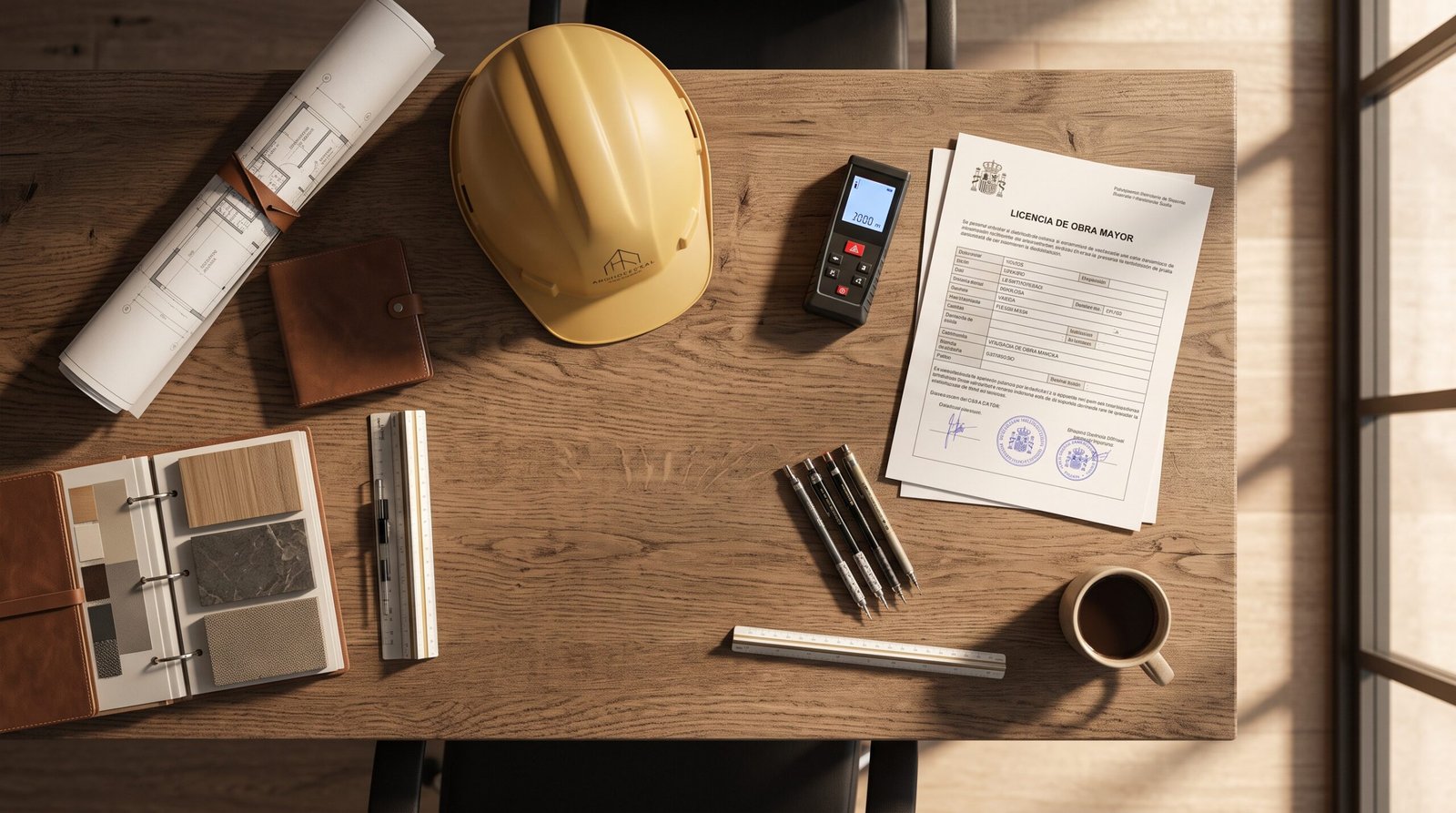
If your renovation ambitions are larger, you cross the threshold into a Licencia de Obra Mayor (Major Work License). This is a rigorous, highly regulated process that requires formal approval before a single brick is touched.
What it covers: Any intervention that changes the core nature of the property.
- Knocking down or altering structural walls or load-bearing pillars.
- Increasing the total volume or footprint of the property (e.g., closing in a terrace to create a new bedroom, adding a roof extension).
- Altering the exterior facade (including changing the size of external windows).
- Changing the official use of a premises (e.g., converting a commercial local into a residential apartment).
The Procedure: You cannot simply submit a budget. You must hire a registered Spanish Architect (Arquitecto) or Technical Architect (Aparejador) to draft a formal Technical Project (Proyecto Técnico). This project must be endorsed by the official Architects’ College (Colegio de Arquitectos) and submitted to the Urban Planning department. Wait times for a Major License in Adeje can range from several months to over a year, depending on the complexity of the project.
3. The ICIO Tax: Paying the Town Hall
Licenses are not free. Regardless of whether you are submitting a Comunicación Previa or applying for an Obra Mayor, you must pay a municipal tax known as the ICIO (Impuesto sobre Construcciones, Instalaciones y Obras), alongside administrative urban fees (Tasas Urbanísticas).
The ICIO is calculated as a percentage (typically between 3% and 4%) of your contractor’s total Material Execution Budget (Presupuesto de Ejecución Material).
- The Trap: Some owners try to submit artificially low budgets to the Town Hall to save on the ICIO tax. The Adeje Urban Planning department uses standardized municipal cost tables; if your submitted budget is unrealistically low for the scope of work, they will reject it and issue an updated tax demand based on their own valuation.
4. The Second Barrier: The Community of Owners
Securing a license from the Adeje Town Hall is only half the battle. If your property is part of a complex (e.g., an apartment or a townhouse within a gated community), you are strictly bound by the Spanish Horizontal Property Law (Ley de Propiedad Horizontal – LPH).
Even if the Town Hall grants you a license to close your terrace with glass curtains or change your external front door, you cannot execute the work unless the Community of Owners (Comunidad de Propietarios) explicitly approves the alteration in an official general meeting. The Community’s aesthetic rules supersede municipal permissions regarding exterior changes.
Before authorizing your contractor to begin any demolition or installation, ensure your legal representative has verified that your specific project scope matches the correct municipal permit, thereby protecting your investment from paralyzing stop-work orders and administrative fines.