Transfer Tax (ITP) vs. IGIC: Calculating Your True Acquisition Costs in Costa Adeje

Understanding the exact tax burden of a property acquisition in Tenerife requires more than a simple percentage calculation. Because the Canary Islands operate as a special economic zone outside the standard European VAT area, the tax framework here differs significantly from mainland Spain.
Whether you are acquiring a resale apartment in Torviscas, buying off-plan in Callao Salvaje, or sourcing a newly built luxury villa in La Caleta, your closing costs depend strictly on the property’s legal classification and its official cadastral value.
1. Resale Properties: The 6.5% ITP and the Cadastral Trap
When you purchase a second-hand property (resale) in Costa Adeje, the transaction is subject to the Property Transfer Tax, known as ITP (Impuesto sobre Transmisiones Patrimoniales).
- The 2026 Rate: The general ITP rate in the Canary Islands is locked at 6.5%. This is significantly lower than mainland Spain, where buyers in regions like Valencia or Catalonia face ITP rates up to 10%.
- The “Valor de Referencia” Trap: You do not automatically pay 6.5% on your agreed purchase price. By law, the tax is calculated on the purchase price or the government’s official Cadastral Reference Value (Valor de Referencia), whichever is higher.
- Complementary Tax Assessments: If you negotiate a fantastic deal and buy a villa for €600,000, but the Spanish Catastro values it at €700,000, you must pay the 6.5% ITP on the €700,000 figure. Paying based on the lower price will trigger an automatic complementary tax bill (complementaria) plus delay penalties from the Canarian Tax Agency.
- AJD Exemption: Resale properties paying ITP are entirely exempt from paying Stamp Duty (AJD) on the purchase deed.
2. New Build & Off-Plan: The 7% IGIC and AJD Protocol
If you are buying a brand-new property directly from a real estate developer (promotor), you do not pay ITP. Instead, this “First Transmission” is subject to the Canary Islands General Indirect Tax, known as IGIC.
- The IGIC Advantage: The IGIC rate for new residential property in Tenerife is 7%. This replaces the standard 10% IVA (VAT) applied to new builds on mainland Spain.
- Off-Plan Stage Payments: If you are buying a property off-plan (sobre plano), you do not pay the total IGIC at the end. The 7% IGIC is applied proportionally to every stage payment you make to the developer during the construction phase.
- The AJD Requirement: Unlike resale properties, all new builds subject to IGIC must also pay Stamp Duty, known as AJD (Actos Jurídicos Documentados). In the Canary Islands, the standard AJD rate for these transactions is 1%.
- The “Reformed” Exception: Buying a fully renovated apartment from a flipper does not usually qualify as a “First Transmission.” Unless the property underwent a legally licensed structural rebuild (rehabilitación integral), it is still classified as a resale and taxed at the 6.5% ITP rate.
3. The Comprehensive “True Cost” Matrix
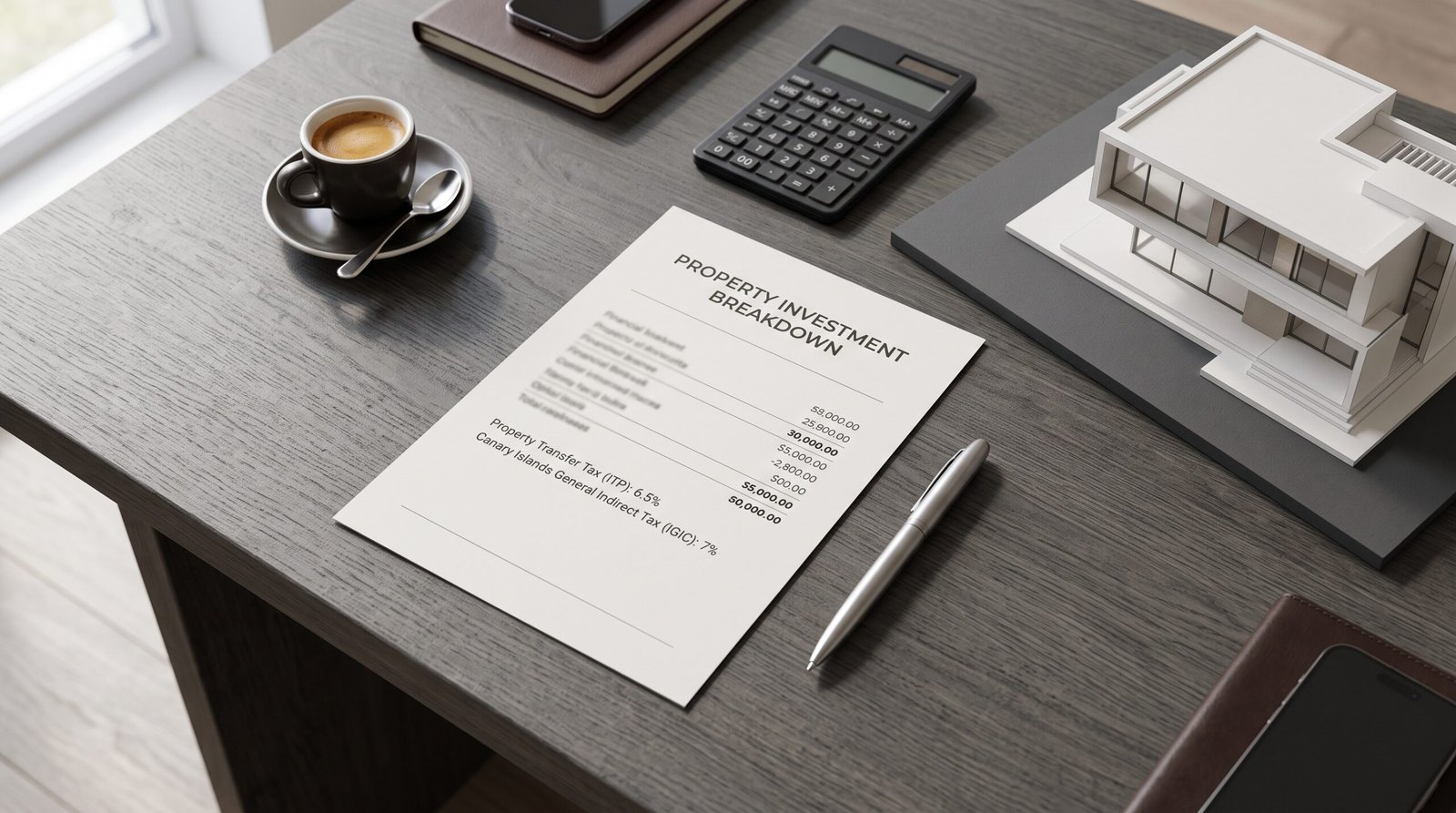
Taxes are the largest expense, but calculating your total liquid capital requirements must include professional fees. Here is a realistic, side-by-side cost estimation for a €750,000 acquisition in Costa Adeje:
| Expense Item | Resale Property (ITP) | New Build Property (IGIC) |
|---|---|---|
| Purchase Price | €750,000 | €750,000 |
| Primary Property Tax | €48,750 (6.5% ITP) | €52,500 (7% IGIC) |
| Stamp Duty (AJD) | €0 (Exempt) | €7,500 (1%) |
| Independent Legal Fees (1%) | €7,500 | €7,500 |
| Notary & Land Registry | ~€3,500 | ~€3,500 |
| Total Liquid Capital Needed | €809,750 | €821,000 |
4. Deadlines, Models, and Compliance
The Spanish tax system does not automatically deduct these funds from your bank account; they must be actively declared and paid within strict legal timeframes.
- The 30-Day Rule: You have exactly 30 working days from the moment you sign the final title deed (Escritura de Compraventa) at the Notary Public to file the tax declarations and pay the total amount.
- Tax Forms: ITP is settled using Modelo 600, while IGIC on property purchases relies on Modelo 412 (or directly via developer invoicing).
- Gestoría Withholding: If you are using a Spanish mortgage to fund the purchase, the bank’s administrative agency (Gestoría) will forcefully withhold the estimated tax amounts from your account on the day of signing to guarantee the Spanish government is paid on time.
5. Bank Repossessions (Embargos Bancarios)
A common misconception among foreign investors is that bank-owned properties are treated differently under Canarian tax law. From a fiscal perspective, purchasing a foreclosure or a bank portfolio asset from entities like Solvia, Aliseda, or Servihabitat is legally classified as a resale (Second Transmission).
- The Tax Rate: You will pay the standard 6.5% ITP, not the 7% IGIC, and the transaction is exempt from the 1% AJD.
- The Valuation Risk: The Valor de Referencia rule strictly applies to bank repossessions. Even if the bank sells you a distressed asset at a massive discount, the Canarian Tax Agency will force you to pay the 6.5% ITP based on the government’s official cadastral valuation, not your discounted purchase price. Always check the official value before signing the Arras.
Navigating the distinction between ITP and IGIC is not just an accounting exercise; it dictates your total liquidity requirement from day one. Before transferring any deposit or committing to a purchase deed in Costa Adeje, ensure your independent legal counsel audits the property’s Cadastral Reference Value (Valor de Referencia) and confirms its exact fiscal classification to avoid costly retroactive tax assessments from the Canarian authorities.