Buying a “Lock-and-Leave” Property in Costa Adeje: Security, Community Rules, and Real Holding Costs

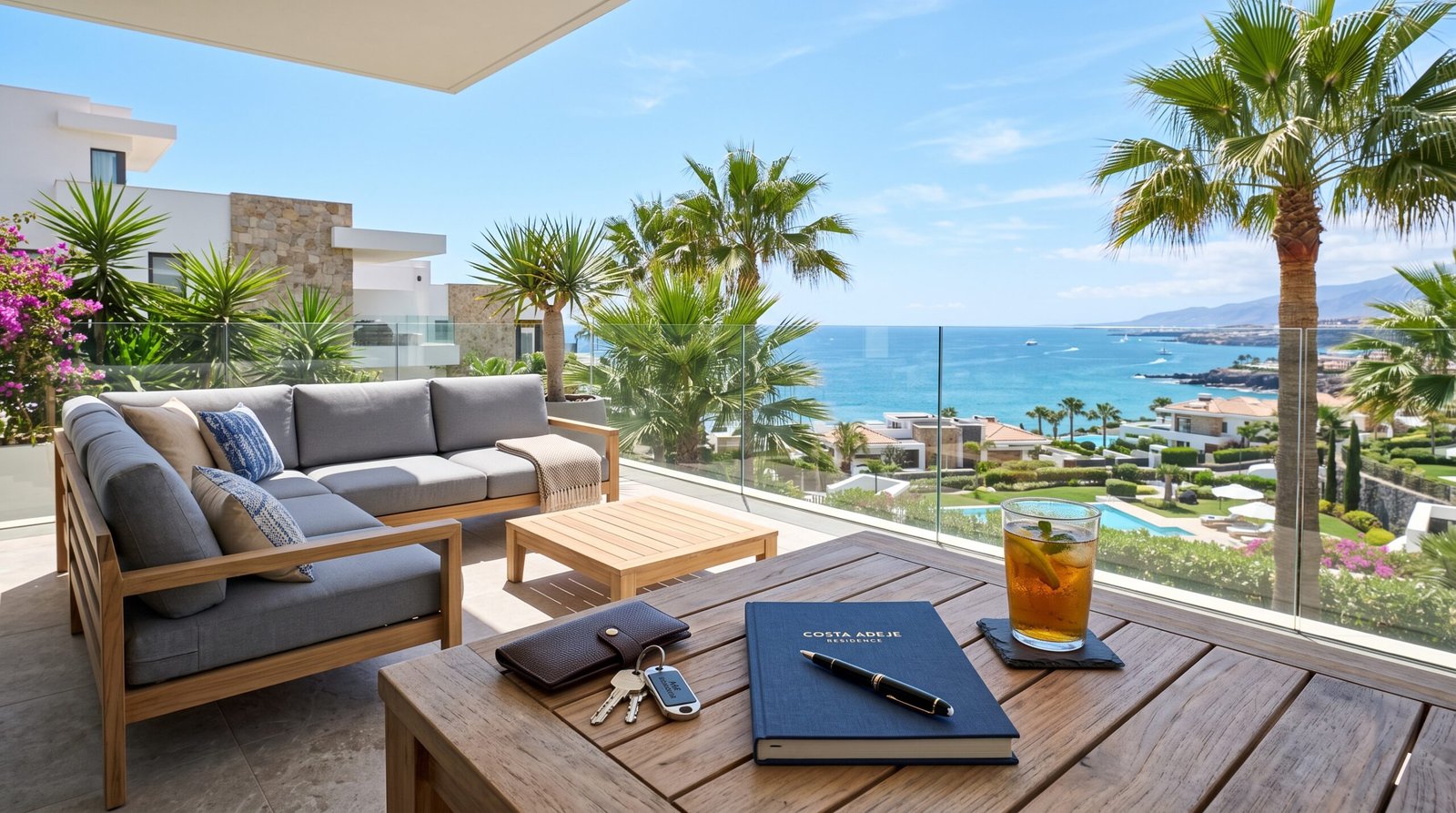
For international buyers and winter residents, the “lock-and-leave” property concept in Costa Adeje represents the ideal balance: a premium winter residence in areas like El Duque, La Caleta, or Madroñal, which can be secured and left completely unoccupied during the summer without operational risks or structural deterioration.
However, maintaining an empty apartment or villa for six or seven months a year in southern Tenerife is not without administrative, legal, and financial challenges. Beyond physical security risks, owners face a strict fiscal framework, permanent fixed costs, and severe community regulations that can completely block any intention of temporary monetization through tourist rentals.
This guide details the protection mechanisms of gated residential complexes, the legal restrictions regarding holiday homes under Canary Islands legislation, and the exact calculation of fixed holding costs for an unoccupied home during the warm season.
1. The Security of Gated Complexes: The Protection Standard in the South
One of the main reasons “lock-and-leave” investors opt for apartments within a community of owners (Comunidad de Propietarios) over isolated villas is passive and active security.
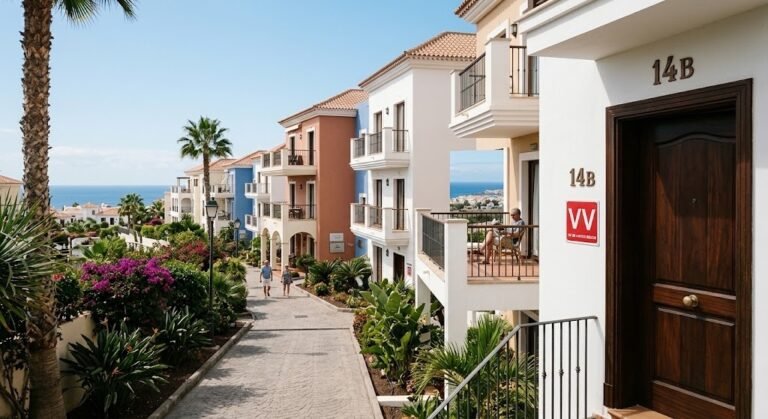
- Secured Perimeter and Controlled Access: Established residential complexes in Costa Adeje feature closed-circuit television (CCTV) surveillance systems across the perimeter, automated card/code-operated gates, and, in exclusive urbanizations, reception security staff or night patrols.
- Deterring Illegal Occupations (Okupas): The presence of a porter (conserje), permanent gardening teams, and vigilant neighbors practically eliminates the risk of break-ins or unauthorized occupation, a phenomenon that almost exclusively targets isolated, bank-owned, or unmonitored properties.
- Connected Active Systems (CRA): For complete peace of mind during the summer, owners install alarm systems directly connected to a rapid response dispatch center in Spain (such as Securitas Direct or Prosegur), equipped with photo-volumetric sensors and an independent 4G/GSM connection resistant to power outages.
2. The Tourist Rental Trap: Why the Community Can Ban the VV License
Many buyers falsely assume they can offset fixed summer costs by listing the property on short-term rental platforms while they are away. In 2026, this option is often blocked from two legal directions: the Horizontal Property Law and the new Canary Islands tourism legislation.
The 3/5 Majority Vote (Article 17.12 of the Horizontal Property Law – LPH) Based on reforms to the Horizontal Property Law, homeowner associations in Spain hold the legal authority to limit or explicitly prohibit tourist rental activities (Vivienda Vacacional – VV) within the building:
- Required Quorum: The decision to ban tourist activity requires the favorable vote of three-fifths (60%) of the registered owners, who must simultaneously represent three-fifths of the property’s participation quotas.
- Community Surcharge: The same 3/5 majority can vote to apply a surcharge of up to 20% on ordinary community expenses for units legally operating as holiday homes.
- Inscription in the Land Registry (Registro de la Propiedad): For the ban to be enforceable against new buyers, the modification of the community statutes (Estatutos) must be notarized and inscribed in the Land Registry. If you purchase an apartment in a complex where the ban has been legally registered, you will not be able to operate a VV license, regardless of your initial intentions.
Regional Sustainable Tourism Framework (LOSUTV and Law 7/2026) Even if the homeowners’ association has not voted for a ban, regional regulations (Ley 6/2025 updated by Ley 7/2026) mandate that any tourist dwelling must hold an urban compatibility certificate issued directly by the Ayuntamiento de Adeje. For existing operators, July 31, 2027, represents the strict deadline for submitting technical documentation and the prior notice of classified activities, with non-compliance leading to the automatic extinction of the exploitation title. A property purchased strictly for personal residential use does not benefit from these procedures without the town hall’s urban planning approval.
3. Real Holding Costs When the Property is Unoccupied
Calculating the annual budget for a “lock-and-leave” home requires considering all taxes and connection costs that continue to accrue even when water and electricity consumption is zero.
A. Local Property Tax (IBI) and Rubbish Tax (Tasa de Basura)
- IBI (Impuesto sobre Bienes Inmuebles): This is the annual municipal tax collected by the Ayuntamiento de Adeje, calculated based on the property’s cadastral value. For a standard 2-bedroom apartment in areas like Fañabé, San Eugenio, or Madroñal, the IBI ranges between €350 and €700 per year.
- Rubbish Tax (Tasa de Basura): Paid semi-annually to the local administration in Adeje, representing a fixed sanitation quota of approximately €80 to €150 per year.
B. Community Fees (Gastos de Comunidad) Owners have a statutory obligation to contribute monthly or quarterly to the maintenance of common areas, pools, gardens, and the mandatory 10% legal reserve fund (fondo de reserva) imposed by the LPH:
- For a well-regarded residential complex in Costa Adeje, community costs range between €120 and €250 per month (i.e., €1,440 – €3,000 annually).
- Luxury complexes with extensive facilities (heated pools, panoramic elevators, concierge) can exceed €350 – €500 per month.
C. Basic Utilities: Contracted Power and Connections Completely canceling utility contracts during the summer is a strategic error, as reconnection requires the issuance of a new electrical technical bulletin (Boletín Eléctrico / CIE) and high connection fees. Bills during your absence reflect fixed components (términos fijos):
- Electricity (Endesa / e-distribución): Even with the main breaker disconnected, the fixed charge for contracted power (término de potencia) generates a baseline bill of €25 – €40 per month.
- Water and Sewage (Entemanser): In the Adeje municipality, the fixed subscription and meter maintenance fee charged by the utility company Entemanser ranges between €20 and €35 per month.
- Fibre Optic Internet: Maintaining an active connection for security cameras and smart home systems incurs a standard monthly cost of €30 – €50.
D. Imputed Income Tax for Non-Residents (Modelo 210) Property owners who are not fiscal residents in Spain and keep their home strictly for personal use are subject to the presumed income tax (Renta Imputada):
- The calculation base represents 1.1% (if the cadastral value was revised in the last 10 years) or 2% of the property’s cadastral value.
- The tax rate is 19% for EU/EEA fiscal residents and 24% for third-country citizens (including the UK and the US).
- For an apartment with a cadastral value of €100,000, the annual fiscal cost declared via Modelo 210 is approximately €209 (for EU citizens) or €264 (for non-EU citizens).
E. Home Insurance (Seguro de Hogar) A comprehensive policy is critical to cover the building structure (continente), interior belongings (contenido), and a minimum civil liability of €300,000. If a pipe bursts in August when the apartment is empty and floods the property below, costs without an active policy are devastating. The average price is €200 – €400 per year.
Budget Summary: Estimated Annual Fixed Cost for a 2-Bedroom Apartment (Costa Adeje)
| Expense Category | Estimated Monthly Cost | Estimated Annual Total |
|---|---|---|
| Community of Owners (Comunidad) | €130 – €220 | €1,560 – €2,640 |
| Local Tax (IBI Adeje) | ~€35 – €55 (amortized) | €400 – €650 |
| Rubbish Tax (Basura) | ~€8 – €12 (amortized) | €90 – €140 |
| Electricity (Endesa Fixed Power) | €25 – €40 | €300 – €480 |
| Water & Sewage (Entemanser Fixed Quota) | €20 – €35 | €240 – €420 |
| Fibre Internet (Security Systems) | €30 – €45 | €360 – €540 |
| Home Insurance (Seguro de Hogar) | ~€20 – €30 (amortized) | €240 – €360 |
| Non-Resident Tax (Modelo 210) | ~€20 – €35 (amortized) | €250 – €420 |
| TOTAL ESTIMATED HOLDING COSTS | ~€268 – €472 / month | ~€3,440 – €5,650 / year |
Technical Closing Protocol for the Warm Season
To prevent damages caused by summer heat and the salty air in the south of the island, owners must apply a strict procedure before departing:
- Shutting Off the Main Water Valve: Turn off the main supply valve inside the apartment and drain the plumbing to remove pressure from boilers and flexible hoses.
- Managing Electrical Breakers: Leave only the dedicated circuits for the Wi-Fi router, alarm panel, and refrigerator (if left running) connected. Disconnect the breakers for the boiler, oven, and secondary outlets.
- Protection Against Humidity and Calima: Lower the exterior blinds (persianas) down to the ventilation slots to block direct solar radiation, install chemical moisture absorbers in the rooms, and ensure floor drains have an oil film or are covered to prevent the evaporation of the hydraulic water seal and the entry of sewer odors.
- Contracting a Keyholding Service: Appoint a licensed local agency in Costa Adeje to physically inspect the property every two weeks, check the mailbox, and ventilate the space.
A “lock-and-leave” property offers total independence and seasonal comfort in Costa Adeje, provided the legal audit of the community is rigorously conducted before purchase, and recurring maintenance expenses are correctly anticipated in the financial plan.
Here is a list of the most important things you must not forget as a buyer:
- Community Rules (LPH): Always check if the homeowners’ association has voted to ban tourist rentals (VV) with a 3/5 majority, as this will block any intention to monetize the apartment in the short term.
- The Utilities Trap: Never cancel your electricity and water contracts during your absence; reconnecting the power requires the issuance of a new technical certificate (Boletín Eléctrico/CIE) and will generate unnecessary additional fees.
- PDF Tax Obligations: Do not forget the annual obligation to file the Modelo 210 form for non-resident imputed income and to pay municipal taxes (IBI and Tasa de Basura), which are mandatory even for the months when the property is unoccupied.
- Independent Legal Verification: Hire an independent lawyer to verify outstanding community debts and the urban legality of the complex; the Spanish notary only ensures the legality of the transaction’s form, not the on-the-ground investigations.