
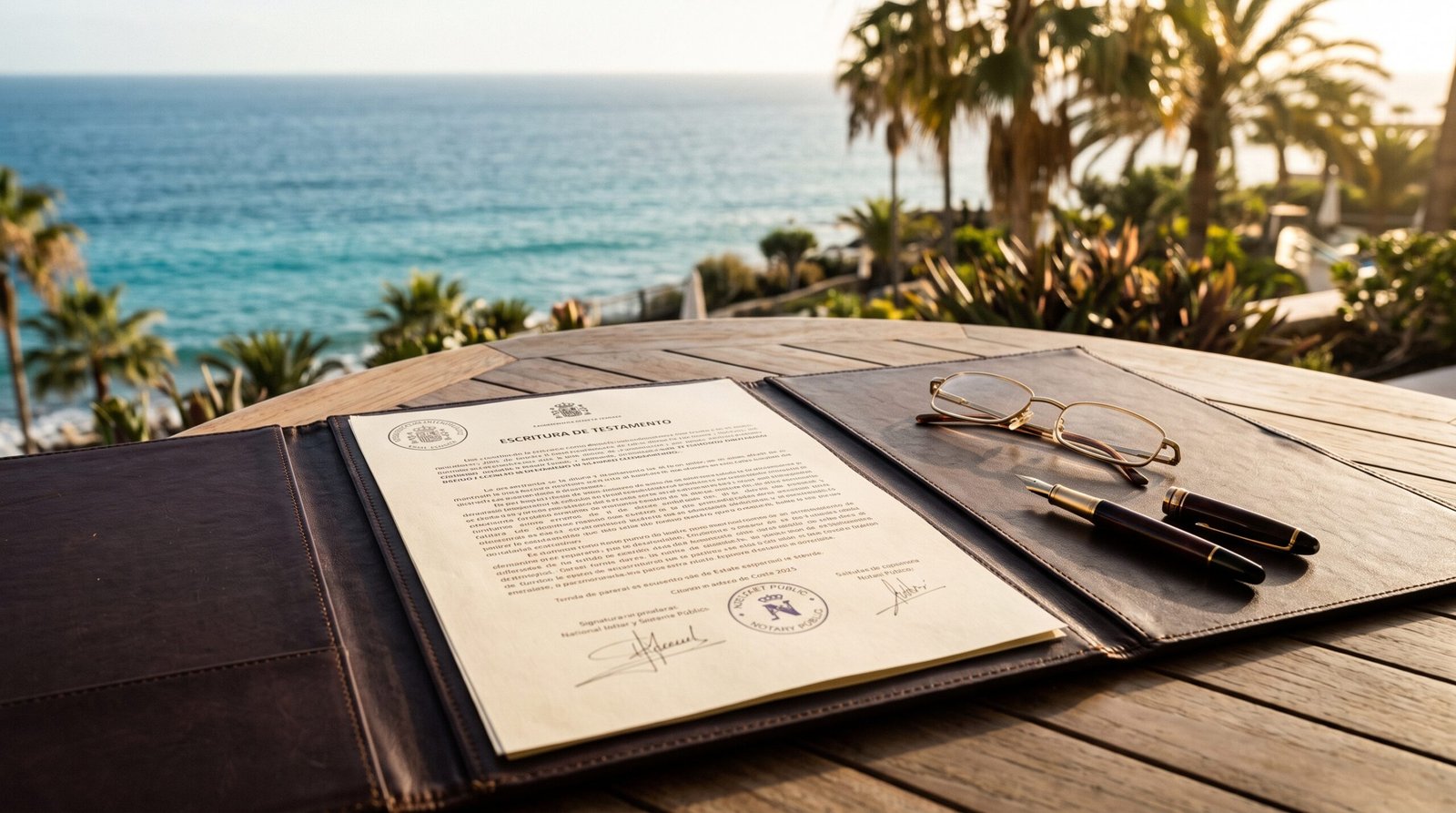
Canary Islands Inheritance Tax: The 99.9% Rule and Spanish Wills in Costa Adeje

Acquiring a prime residential asset in Costa Adeje—whether a frontline villa in La Caleta, an estate in Golf Costa Adeje, or a penthouse overlooking Playa del Duque—represents both a lifestyle choice and a significant generational capital allocation. Yet, for international homeowners, planning how that asset will transition to heirs is as critical as the initial purchase due diligence.
Cross-border estate transfers in Spain frequently become entangled in administrative and fiscal complications. However, the Autonomous Community of the Canary Islands maintains one of the most advantageous inheritance tax regimes in Europe, provided property owners implement proper testamentary structuring.
This guide breaks down the mechanics of the Canary Islands Inheritance and Gift Tax (Impuesto sobre Sucesiones y Donaciones – ISD), the application of the 99.9% regional tax rebate, and why executing a standalone Spanish will is essential for international owners.
1. The Canary Islands 99.9% Tax Allowance (Bonificación)
Under Spanish state baseline law, inheritance tax can reach progressive rates of up to 34% (and significantly higher when multiplier coefficients based on pre-existing net worth are applied). However, Spain’s regional autonomous communities retain statutory authority to establish their own exemptions, tax credits, and deductions.
Under the Canary Islands fiscal framework, the regional government applies a 99.9% tax allowance (bonificación) on inherited estate assets for direct family members:
- Qualifying Heirs: Group I (descendants and adopted children under 21 years of age) and Group II (descendants and adopted children aged 21 or older, legal spouses, and direct ascendants/parents) receive an immediate 99.9% credit on their net tax liability.
- Equal Protection for Non-Residents: Following European Court of Justice jurisprudence and Spanish Supreme Court rulings, non-resident heirs—whether resident in the EU/EEA or third countries such as the UK, Switzerland, and the United States—benefit from the exact same regional Canary Islands tax deductions on local real estate.
- Practical Fiscal Impact: For direct family heirs inheriting a €2,000,000 villa in Costa Adeje, the net regional inheritance tax is reduced to a nominal fraction of what standard Spanish state rates would otherwise dictate.
2. Why a Local Spanish Will (Testamento Notarial) Is Non-Negotiable
A widespread mistake among foreign property owners in Tenerife is assuming that an existing home-country will (e.g., drafted under English, Scottish, German, or Scandinavian law) is sufficient to transfer a Costa Adeje property seamlessly.
Under EU Succession Regulation (Brussels IV, Regulation EU 650/2012), foreign wills are legally valid in Spain, but probating an estate using an overseas will creates substantial administrative friction:
- Overseas Grant of Probate: Heirs must first conclude probate proceedings in the deceased’s home jurisdiction.
- Legalization and Apostille: All court probate orders, certificates, and foreign wills must be legalized with the Hague Apostille.
- Sworn Translations: The entire legal package must be translated into Spanish by a Ministry-certified sworn translator (traductor jurado).
- Lengthy Delays: The process often takes between 6 and 18 months, during which Spanish bank accounts are frozen and properties cannot be sold, remortgaged, or formally registered under the heirs’ names.
The Solution: Executing a standalone Spanish Will (Testamento Notarial de Bienes en España), drafted specifically to govern only assets located in Spanish territory.
The will is executed before a Spanish Notary in Adeje or South Tenerife and immediately registered with the Central Registry of Last Wills (Registro General de Actos de Última Voluntad) in Madrid. Upon death, heirs simply request an official certificate of last will, present the certified death certificate, and execute the deed of acceptance of inheritance (Escritura de Aceptación y Adjudicación de Herencia) before the notary without waiting for overseas courts.
3. Choosing Your Governing Law: The Brussels IV Clause
Spanish civil law operates under the doctrine of forced heirship (herederos forzosos), meaning parents cannot freely disinherit children, as statutory quotas (two-thirds of the estate) are legally reserved for direct descendants.
Under Article 22 of EU Regulation 650/2012, the succession of an estate is governed by default by the law of the state where the deceased had habitual residence at the time of death. However, the regulation grants individuals the right to choose the law of their nationality (professio juris) to govern their entire estate.
If your home legal system (such as English law) permits complete testamentary freedom, you can insert an express clause into your Spanish will stating that the disposition of your Spanish property shall be governed strictly by the national law of your citizenship. This prevents conflicts with Spanish forced heirship provisions, allowing you to distribute your Costa Adeje estate according to your exact wishes.
4. Critical Deadlines: The 6-Month Statutory Window
Settling an estate in the Canary Islands is governed by strict statutory deadlines:
- The 6-Month Window: Heirs have exactly six calendar months from the date of death to declare and pay both the Regional Inheritance Tax (Impuesto sobre Sucesiones) and the Municipal Capital Gains Tax (Plusvalía Municipal / IIVTNU) levied by the Ayuntamiento de Adeje.
- Requesting an Extension: An official six-month extension can be requested from the Tax Agency, but this formal petition must be submitted before the end of the fifth month following the death. Missing this five-month window results in automatic forfeiture of the right to an extension, exposing the estate to statutory late-payment surcharges (recargos) and interest.
- Mandatory NIE for Beneficiaries: Every heir must obtain a Spanish Foreigner Identification Number (NIE) and, where necessary, grant a formal Power of Attorney (Poder Notarial) to their local legal representative to execute the acceptance deed before the notary.
Key Takeaway for Costa Adeje Homeowners
The Canary Islands offer an exceptionally protective inheritance framework for direct descendants and surviving spouses. However, that protection is accessible only if the procedural roadmap is prepared during your lifetime.
Executing a localized Spanish will and establishing an explicit choice-of-law clause ensures that your high-value assets in Tenerife transition to the next generation without bureaucratic deadlock, excessive probate expenses, or unnecessary tax liabilities.