Public vs. Private Healthcare for Expats in Tenerife: Access and Requirements in Adeje

Relocating to Costa Adeje requires a forensic approach to personal infrastructure, where health and residency status are inextricably linked. For international professionals and investors, navigating the Spanish healthcare system can appear opaque, complicated by regional Canarian regulations and post-Brexit adjustments. Understanding the dual-track structure—the universal public system (Sistema Nacional de Salud or SNS) and the robust private network—is the essential final step in securing a seamless transition to life in Tenerife South.
Spain operates a hybrid model. The public system is universal, based on residency and social security contributions,rather than direct payment at the point of care. Private healthcare, conversely, functions as a paid parallel network,offering expedited access to specialists and modern facilities. For expats in Adeje, the decision between the two is rarely binary; instead, it is a strategic calculation based on visa type, financial capacity, and specific medical requirements.
The Public System in Adeje: universal Access via Residency
The public healthcare system in Adeje, managed regionally by the Canary Islands Health Service (Servicio Canario de la Salud or SCS), is of a high standard. Access is founded on the principle of residency and compulsory contribution.Therefore, property ownership alone does not grant automatic access. To enter the SCS, you must be legally resident in Spain and contributing through employment, self-employment (autónomo), or, crucially, utilizing a pension from an EU/EEA country.
The operational architecture of public care begins at the local Centro de Salud. In the municipality of Adeje, primary care is centralized in the main facility in Adeje Pueblo. This is the mandatory first point of contact for all non-emergency, primary care consultations (Medicina de Cabecera). Here, you are assigned a specific family doctor who manages all outpatient care, electronic prescriptions (Receta Electrónica), and necessary referrals to public specialists.Public hospital emergencies (Urgencias) are handled by large tertiary hospitals like the Hospital Universitario de Canarias (HUC) and La Candelaria in Santa Cruz for acute cases, with smaller local emergency units closer to the South.
The SCS Access Protocol: Four Mandatory Steps
To register with a Centro de Salud in Adeje in 2026, a strict, sequential administrative process must be followed:
1. The Padrón Municipal: You must be registered on the municipal census (padrón) at the Ayuntamiento de Adeje Town Hall. This document validates your physical presence in the municipality, which dictates your Centro de Salud assignment.
2. Social Security Number: You require a Spanish Social Security number. If you are employed or an autónomo, this is generated automatically with your NIE. UK retirees (holding an S1 form) and other EU pensioners must formally register their entitlement at the Tesorería General de la Seguridad Social (TGSS), often at the offices in Los Cristianos or Las Américas, transforming their foreign entitlement into active Spanish coverage.
3. Health Centre Registration: You must present your TIE (residency card), your padrón certificate (dated within the last three months), and proof of Social Security enrollment at the administration desk of the Adeje Pueblo Centro de Salud.
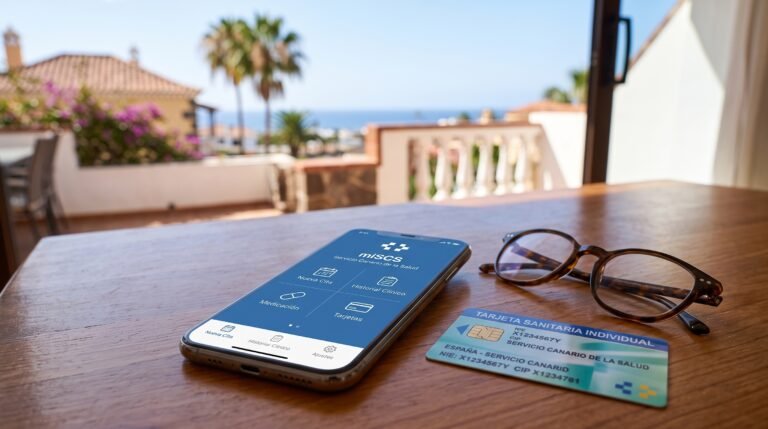
4. The Tarjeta Sanitaria: Upon successful registration, the SCS issues your physical Tarjeta Sanitaria Individual(TSI). This plastic card contains your CIP number (the personal identification code) and must be presented at all public medical centers and pharmacies to access prescriptions.
The Private Sector: An Expedited Alternative for Costa Adeje
Tenerife South boasts one of the most developed private healthcare infrastructures in Spain, fueled by the demand of its expatriate and tourism sectors. For long-term residents, particularly in premium enclaves like La Caleta and El Duque,private healthcare is rarely considered optional. It is utilized to neutralize the primary criticism of the Spanish public system: protracted wait times for non-urgent specialist consultations and diagnostic imaging.
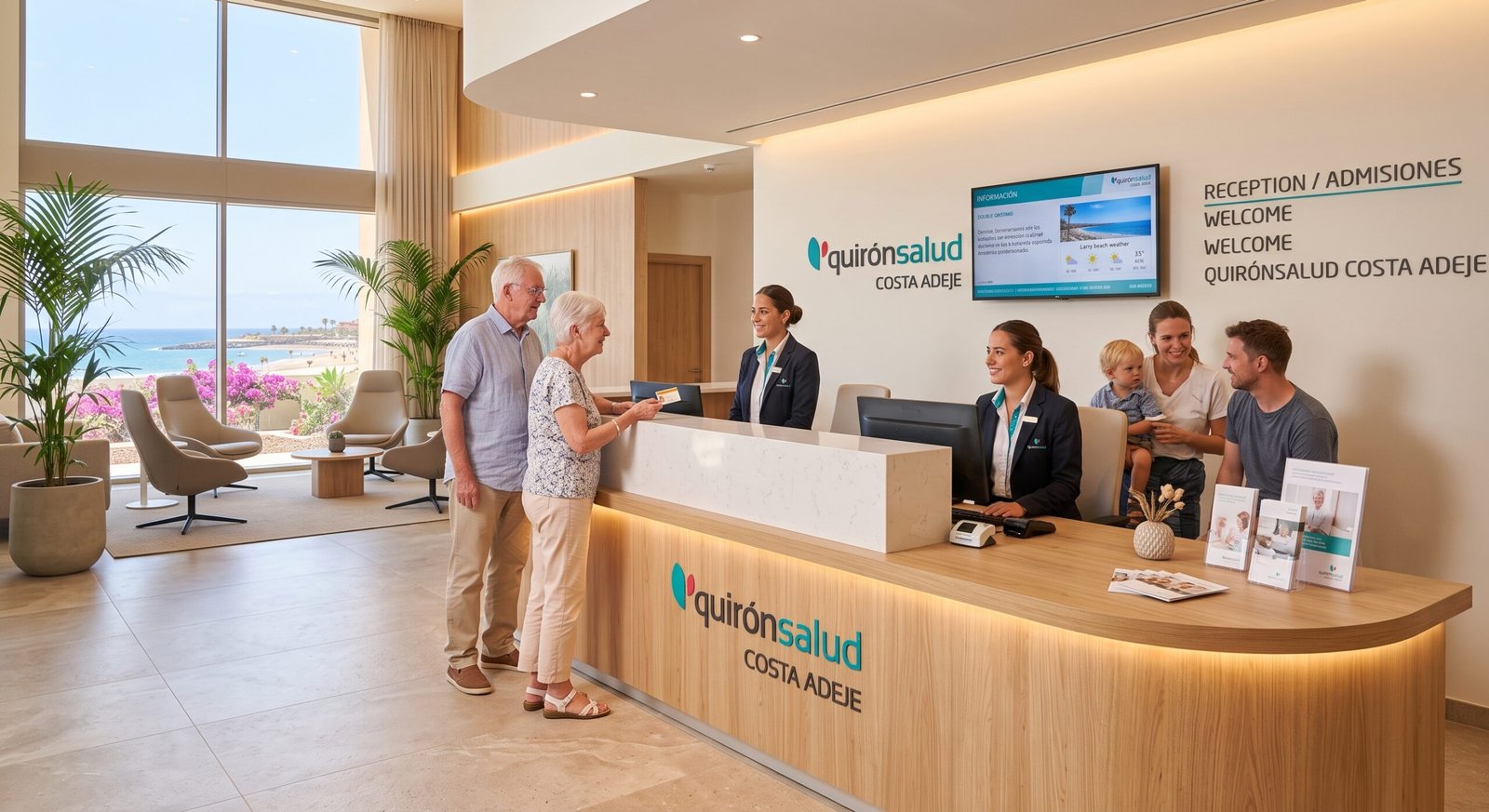
Private medicine in Adeje functions entirely on a fee-for-service basis, overwhelmingly accessed through private health insurance rather than direct cash payments. The main private providers in the South include Hospital Quirónsalud (with a dedicated center in Costa Adeje), Hospiten Sur (near Los Cristianos), and numerous specialized polyclinics such as Clinica del Sol.
The strategic advantages of private cover for expats are tangible. You bypass the Médico de Cabecera, granting direct access to any specialist—from cardiology to dermatology—within days rather than months. Facilities often operate on par with the private sector in Northern Europe, offering modern, single-occupancy rooms during hospitalization and,critically, robust multilingual services, eliminating linguistic friction during critical moments.
Healthcare Requirements for Spanish Residency Visas
The healthcare reality for international citizens is governed not by medical need, but by immigration law. Proper healthcare coverage is the mandatory prerequisite for acquiring and maintaining a Spanish long-stay residency permit.
Non-Lucrative Visas (NLV) and Digital Nomad Visas (Initial Stage): For non-EU citizens (including UK nationals) acquiring these visas, private health insurance is mandatory. Crucially, the policy must meet specific criteria. It must be issued by a Spanish company authorized to operate in Spain, offer comprehensive coverage (no co-payments or deductibles), and, vital in 2026, include repatriation cover. Crucially, it must be fully paid upfront for the first year.
Workers and Golden Visas (Investors): Employees and autónomos (including those on a Golden Visa who opt to work) integrate directly into the public Social Security system and have full SCS access without further insurance.However, family members included under the Golden Visa structure who do not contribute may still require private coverage depending on the precise timing of their residency formalization.
The British Expat Conundrum: S1 Forms Post-Brexit
For the substantial demographic of UK citizens relocating to Tenerife, the post-Brexit healthcare landscape remains nuanced. UK nationals drawing a standard state pension remain eligible for SCS access in Tenerife, but they must utilize the S1 form pathway.
The S1 is the certificate that coordinates healthcare between the UK’s NHS and Spain’s SCS. It must be requested from the UK’s Overseas Healthcare Services. Upon physical arrival in Adeje, the original S1 form, TIE, and padrón must be formally registered at the Spanish TGSS office. Only once this transfer of liability is complete can the individual register with the Adeje Pueblo Centro de Salud and receive their Canarian TSI health card. Until that process is fully finalized, a premium Spanish private health policy remains the only secure option for ensuring access and validating residency.
Costa Adeje, perhaps more than any other sector of Tenerife, exemplifies Spain’s functioning hybrid healthcare model.While the public system provides robust emergency and chronic care, the efficiency and multilingual integration of the private Hospiten and Quirón networks remain the operational necessity for an elevated expat lifestyle. For investors and relocated professionals, the initial procedural complexity of public registration must be balanced by the strategic acquisition of a Spanish private policy, ensuring that health infrastructure, like real estate asset structures, is finalized before enjoying the unique quality of life in Tenerife South.